20-Minute FTP Test
75 min · 67-82 TSS · IF 0.76 · Max effort (test) · All zones
What this workout does
The classic Allen & Coggan FTP protocol - a thorough warm-up, a 5-minute all-out clearing effort, then one maximal 20-minute effort. The most widely used benchmark in cycling.
Your best 20-minute power is always a little higher than your true FTP, because anaerobic energy tops it up. The protocol corrects for this twice: the 5-minute clearing effort burns off part of that reserve before you start, and the 0.95 multiplier discounts what is left. The 0.95 is a population average: riders with a strong sprint often test truer around 0.90-0.92, pure diesels closer to 0.95. It doubles as a hard threshold session, and pacing it well is a skill that transfers straight to time trials and long climbs. Test on fresh legs, then retest every 6-8 weeks under the same conditions.
How to ride it
Indoor / trainer
Warm up 20 minutes easy, then ride three 1-minute fast-pedal efforts at 100+ RPM. After 5 easy minutes, ride 5 minutes ALL OUT - this clearing effort is part of the protocol, not a mistake. Recover 10 minutes, then ride the 20-minute effort as hard as you can sustain evenly: start near 100% FTP, hold steady through the middle, and empty the tank in the final 5 minutes. On a smart trainer, switch to slope or resistance mode for the clearing effort and the test itself - the file's targets are a floor to pace against, not a cap, and ERG mode would hold you back. Your new FTP is your 20-minute average multiplied by 0.95. Cool down easy.
Outside
An indoor trainer gives the cleanest result. Outdoors, you need 20 uninterrupted minutes - a long steady climb at 4-7% or a flat road with no stops or corners - plus a safe stretch for the 5-minute clearing effort. Start the 20 minutes at what feels like 100% FTP, breathing hard but controlled, and resist the urge to surge early.
Workout structure (75 min)
- Warm-up 20m 60%

3x
- Fast pedal 1m 65% 105rpm
- 1m 55%

- 5m 55%
- Clearing effort 5m free 115%
- 10m 55%
- Test effort 20m free 103%
- Cool-down 10m 50%
Targets are a percentage of FTP. This is the same shorthand the free workout builder understands — paste it there to edit any step, or download the workout for Zwift, Garmin or any smart trainer.
Finished the test? Enter your result in the FTP calculator to get your FTP and power zones, then see what a good FTP is for your weight.
20-Minute FTP Test FAQ
How long is the 20-Minute FTP Test workout? +
How hard is 20-Minute FTP Test? +
Can I do 20-Minute FTP Test outdoors? +
Why is the 20-minute test result multiplied by 0.95? +
Why is there a 5-minute all-out effort before the 20 minutes? +
How often should I test my FTP? +
Related cycling workouts
Ramp Test
30 min · 36-44 TSS
The standard ramp test - the effort steps up 6% FTP every minute until you can no longer hold the target, so there is no pacing to get wrong. Finds your FTP in under half an hour.
2x8-Minute Test
50 min · 44-54 TSS
Two flat-out 8-minute efforts with a long recovery between them. A friendlier alternative to the 20-minute test - shorter efforts, same answer.
Steady Upper Zone 2
45-90 min · 41-50 TSS
Productive aerobic riding at upper Zone 2. This is where aerobic efficiency gains happen - purposeful effort that builds your cardiovascular engine.
Cadence Play
60-90 min · 52-64 TSS
An upper Zone 2 ride with alternating cadence blocks to improve pedaling efficiency. Low cadence builds strength, high cadence builds coordination.
Progressive Endurance
60-122 min · 65-80 TSS
Gradually build effort across the ride from mid to upper Zone 2. Teaches pacing and finishes in productive aerobic territory.
Hilly Endurance
75-122 min · 59-72 TSS
Use terrain to add variety. Climb in upper Zone 2, recover on descents. The changing effort keeps the ride interesting while building aerobic fitness.
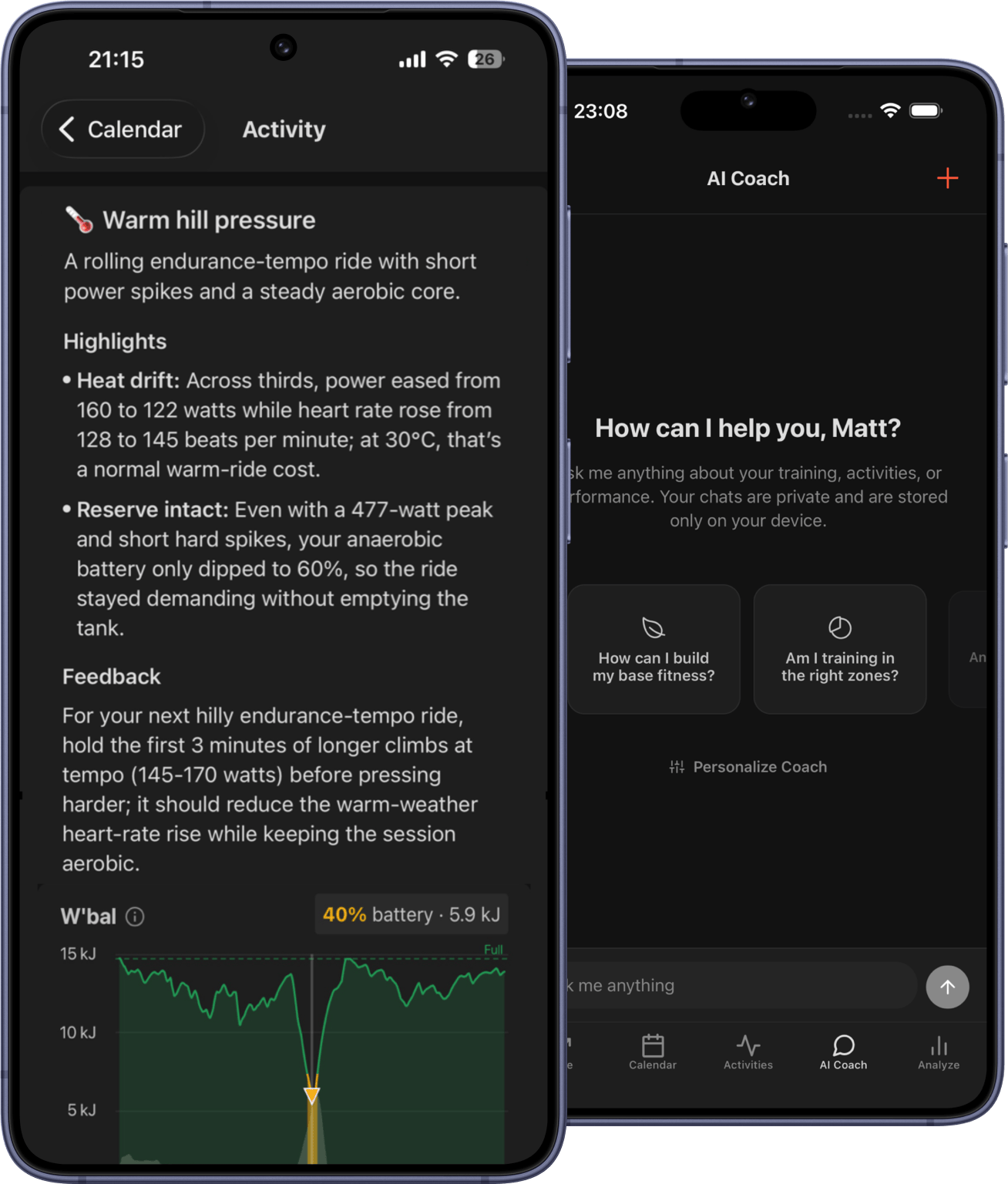
A coach who's seen every ride you've done
Ask FormBeat's AI Coach anything - what to ride today, why a session felt flat, how to pace your next race - and it answers from your real training: your power, your history, how you're recovering. Not generic tips, but a read of what each ride actually meant and what to do next.
The guidance you'd pay a coach for - for the price of an app.