Functional Threshold Power (FTP) Calculator
Estimate your FTP using different test protocols (20-minute, 2×8-minute, ramp, or full 60-minute). Functional Threshold Power (also called FTP) is the maximum amount of power that can be sustainably produced for one hour, measured in Watts. Show more
Don't want to test? Formbeat detects your FTP from your regular rides.
Never do another FTP test
Formbeat analyzes your regular rides and automatically detects when your FTP improves — along with your aerobic base, critical power, power zones, training load, fitness and daily readiness.
30-day free trial · Cancel anytime

“If you find yourself wishing there was just one simple resource you could rely on to fully explain, examine and guide your training, FormBeat could be your answer.”
 Trusted by 20,000+ cyclists
Last updated:
Understanding FTP
Functional Threshold Power is the single most important number for any cyclist training with a power meter. It defines your sustainable effort ceiling and serves as the foundation for all power-based training zones, race pacing, and performance tracking.
What is Functional Threshold Power?
FTP represents the highest average power output you can sustain for approximately one hour. Introduced by Dr. Andrew Coggan, it corresponds closely to your lactate threshold — the intensity where lactate accumulates in the blood faster than your body can clear it. Below your FTP, exercise is primarily aerobic and sustainable. Above it, fatigue accumulates rapidly and forces you to slow down.
For most trained cyclists, FTP falls between 85-95% of the power at which VO2 max occurs. This makes it a practical proxy for your aerobic ceiling without requiring laboratory testing. FTP is expressed in absolute watts (e.g., 250W) or relative to body weight (e.g., 3.5 W/kg), with the latter being more useful for comparing cyclists of different sizes.
How to Calculate Your FTP
To calculate your FTP you ride a short maximal effort — a "field test" — and apply a correction factor that estimates the power you could hold for a full hour. The steps are the same whichever cycling FTP test you choose:
- Warm up properly — 10–15 minutes of easy spinning with a few short, hard bursts to open up your legs.
- Ride the test effort — go as hard as you can hold evenly for the test duration; most cyclists use the 20-minute test.
- Record your average power for the effort, in watts.
- Apply the multiplier — for example 95% of your 20-minute average, or 75% of your best 1-minute power on a ramp test. The FTP calculator above does this for you automatically.
FTP Testing Protocols Compared
There is no single "correct" way to test FTP. Each protocol trades accuracy against practicality and mental demand. Understanding the differences helps you choose the right test for your situation and interpret results correctly.
The 20-minute test is the most widely used protocol. After a thorough warm-up including a 5-minute hard effort to pre-fatigue your anaerobic system, you ride as hard as you can sustain for 20 minutes. Multiply your average power by 0.95 to estimate FTP. This protocol works well for most cyclists but can overestimate FTP for riders with strong anaerobic capacity who can "outperform" the 5% reduction.
The ramp test progressively increases power (typically by 20W per minute) until you can no longer maintain the target. FTP is estimated at 75% of your best 1-minute power achieved during the test. This protocol is shorter, more repeatable, and less mentally taxing, making it popular for frequent testing. However, it can underestimate FTP for "diesel" endurance athletes and overestimate for sprinters.
The 2×8-minute test involves two 8-minute all-out efforts with 10 minutes of recovery between them. Average the two efforts and multiply by 0.90 to estimate FTP. This is a good option for cyclists who struggle with pacing a 20-minute effort or who find longer tests too mentally demanding.
The 60-minute test is the gold standard — a full one-hour all-out effort where your average power equals your FTP directly. While the most accurate, it requires exceptional pacing discipline and mental fortitude. Very few cyclists outside of professional time trialists can produce a true maximal 60-minute effort in training.
FTP by Age, Weight, and Experience Level
Understanding where your FTP falls relative to other cyclists provides context for your training and goals. While absolute watts matter for flat-road speed, watts per kilogram (W/kg) is the universal comparison metric.
Male cyclists: Untrained beginners typically start at 1.5-2.0 W/kg. After 1-2 years of structured training, most reach 2.5-3.5 W/kg. Competitive amateur racers (Category 3-4) typically sustain 3.5-4.0 W/kg. Serious amateurs and Category 1-2 riders range from 4.0-4.8 W/kg. Domestic professionals reach 4.8-5.5 W/kg, and WorldTour professionals sustain 5.5-6.5+ W/kg during stage races.
Female cyclists: Values are approximately 10-15% lower at each level due to physiological differences in muscle mass and testosterone. Competitive amateur women typically range from 3.0-3.5 W/kg, with elite professionals reaching 4.5-5.5 W/kg.
Age considerations: FTP typically peaks in the mid-20s to early 30s. Trained athletes see a decline of approximately 5-8% per decade after age 35, though consistent training significantly slows this process. Many masters cyclists in their 50s and 60s maintain competitive FTP values.
FTP Chart by Cycling Category (W/kg)
This FTP chart shows approximate functional threshold power in watts per kilogram (W/kg) for each cycling level. Use it to turn the W/kg figure from the calculator above into a category, and to set a realistic target for your next FTP score.
| Category | Men (W/kg) | Women (W/kg) |
|---|---|---|
| Developing · Non-racer | 1.86 – 2.43 | 1.50 – 2.02 |
| Building · Category 5 | 2.43 – 3.00 | 2.02 – 2.55 |
| Solid · Category 4 | 3.00 – 3.56 | 2.55 – 3.07 |
| Good · Category 3 | 3.56 – 4.13 | 3.07 – 3.60 |
| Very good · Category 2 | 4.13 – 4.70 | 3.60 – 4.12 |
| Excellent · Category 1 | 4.70 – 5.27 | 4.12 – 4.64 |
| Exceptional · Domestic Pro | 5.27 – 5.83 | 4.64 – 5.17 |
| World class · International Pro | 5.83 – 6.40 | 5.17 – 5.69 |
Values are approximate and vary with age, genetics, and training history. They reflect one-hour FTP, not short sprint power.
How to Improve Your FTP
FTP improvement requires systematic training that targets both your aerobic base and your threshold capacity. The most effective approach combines high-volume Zone 2 training with targeted threshold and VO2 max intervals.
Build your aerobic base: Spend 70-80% of your training time in Zone 2 (56-75% of FTP). This develops mitochondrial density, capillary networks, and fat oxidation capacity — the foundation that supports higher-intensity work. Without a strong base, threshold training produces diminishing returns.
Threshold intervals: "Sweetspot" training at 88-94% of FTP provides the best bang-for-your-buck for FTP improvement. Classic workouts include 2×20 minutes at 90% FTP, or 3×15 minutes at 92% FTP. These sessions challenge your lactate threshold without excessive fatigue accumulation.
VO2 max work: Intervals at 106-120% of FTP lasting 3-8 minutes raise your aerobic ceiling, which in turn allows a higher FTP. Typical workouts include 5×5 minutes at 110% FTP or 6×4 minutes at 115% FTP with equal recovery periods.
Consistency and recovery: Meaningful FTP improvements require 8-12 weeks of consistent training. Adequate sleep, nutrition, and rest days are essential — your body adapts during recovery, not during the workout itself.
Understanding Your FTP Results
Once you know your FTP, you can use it to structure every aspect of your training. All power training zones are derived as percentages of FTP, making it the anchor for workout prescription. Your FTP also feeds into Training Stress Score (TSS) calculations, which quantify the training load of each ride and help manage fatigue and fitness over time.
Compare your result using our How Good Is My FTP tool to see where you stand against established performance categories. Track your FTP over months and years — the trend matters more than any single test result. A gradual upward trend of even 2-3% per quarter represents meaningful improvement for trained cyclists.
Your FTP says how strong you are.
Not how to get stronger.
Two riders with the same FTP can be completely different athletes — one a sprinter who fades, the other a diesel who can't kick. FormBeat reads the difference from the rides you're already doing — your rider type, aerobic efficiency, and critical power — then shows you exactly what to train next.
Frequently Asked Questions
What is FTP in cycling? +
How do I test my FTP? +
What is a good FTP for my weight? +
How often should I test my FTP? +
What's the difference between FTP test protocols? +
What is a good FTP score? +
What does FTP mean in exercise and fitness? +
How can I find my FTP without doing a test? +
Related Tools
All Tools →Power Zones Calculator
Turn your FTP into training zones with exact watt ranges.
How Good is My FTP?
Compare your FTP and W/kg against rider categories.
Critical Power Calculator
Model your critical power and W′ from two or three maximal efforts.
TSS Calculator
Score a ride's training stress from duration, power, and FTP.
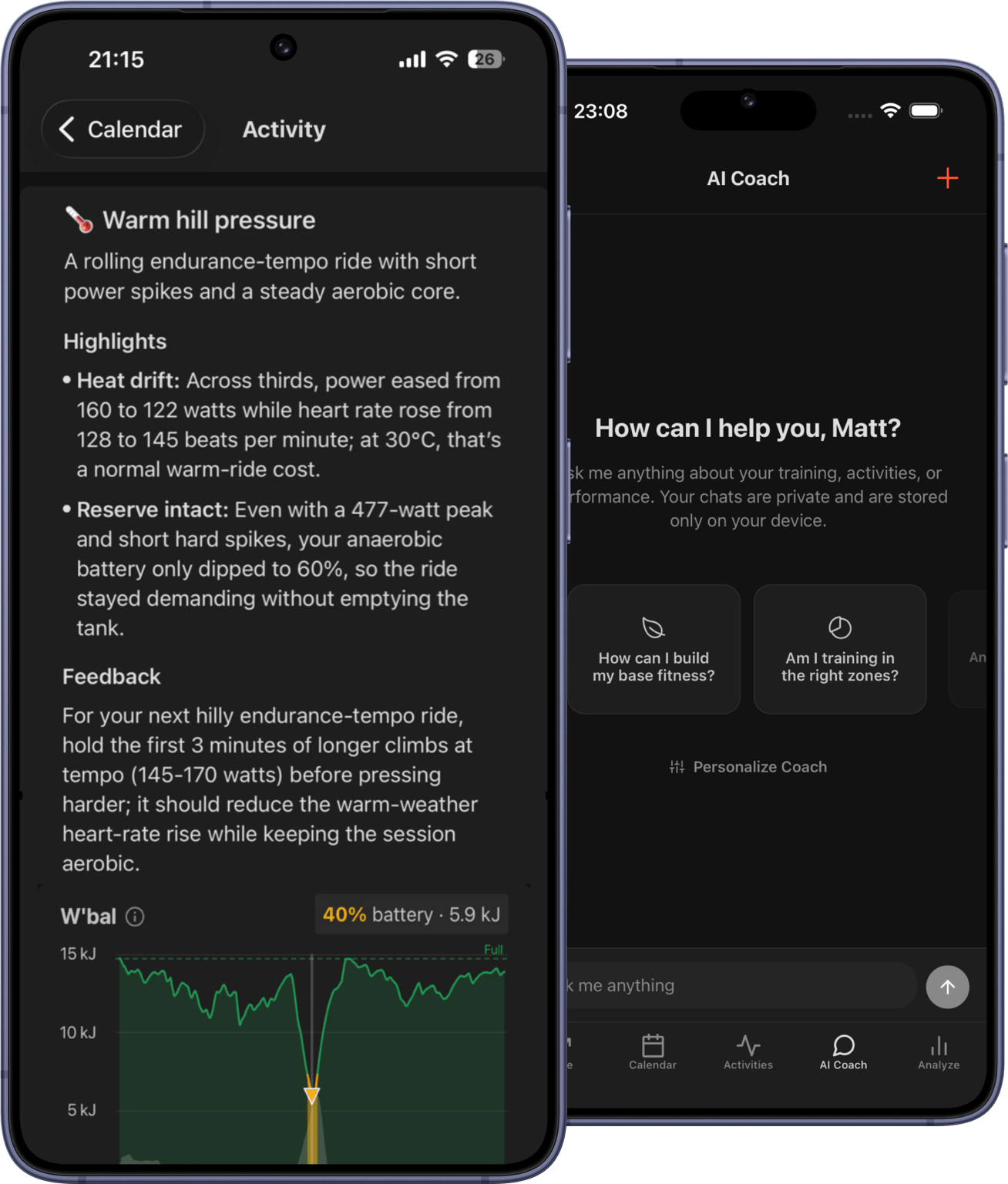
A coach who's seen every ride you've done
Ask FormBeat's AI Coach anything - what to ride today, why a session felt flat, how to pace your next race - and it answers from your real training: your power, your history, how you're recovering. Not generic tips, but a read of what each ride actually meant and what to do next.
The guidance you'd pay a coach for - for the price of an app.