Training Stress Score Calculator
The Training Stress Score Calculator provides a method for estimating the intensity and the resulting physiological stress of a training session. Enter Duration, Normalized Power and your FTP to calculate Training Stress Score of your cycling workout.
Your training load, tracked for you
Connect Strava or Garmin and FormBeat tracks your daily and weekly load, warns you before you overdo it, and suggests what to ride today.
30-day free trial · Cancel anytime


“If you find yourself wishing there was just one simple resource you could rely on to fully explain, examine and guide your training, FormBeat could be your answer.”
 Trusted by 20,000+ cyclists
Last updated:
Understanding Training Stress Score (TSS)
Training Stress Score is the key metric for managing your cycling training load . By combining workout intensity and duration into a single number, TSS helps you balance training stress with recovery to optimize fitness gains and avoid overtraining.
What is TSS and How is it Calculated?
Training Stress Score was developed by Dr. Andrew Coggan as a way to quantify the physiological cost of a workout. The TSS formula is:
TSS = (Duration in seconds × Normalized Power × Intensity Factor) ÷ (FTP × 3600) × 100
- Duration — total ride time in seconds
- Normalized Power (NP) — your power adjusted for how variable the effort was
- Intensity Factor (IF) — Normalized Power divided by FTP
- FTP — your Functional Threshold Power in watts
In simpler terms, a TSS of 100 represents the stress of riding at your Functional Threshold Power (FTP) for exactly one hour. An easy 2-hour endurance ride might score 80-100 TSS, while an intense 1-hour interval session could score 90-120 TSS. The formula accounts for the fact that higher-intensity efforts create disproportionately more physiological stress than steady-state riding.
Typical TSS Values by Ride (TSS Chart)
Use this TSS chart as a rough guide to how much training stress different sessions add:
| Ride type | Duration | Typical TSS |
|---|---|---|
| Recovery spin | 45–60 min | 20–40 |
| Endurance ride | 2–3 hr | 100–180 |
| Tempo / sweet spot | 1–1.5 hr | 70–110 |
| Threshold intervals | ~1 hr | 90–120 |
| Hard race or gran fondo | 3–5 hr | 250–400 |
TSS Guidelines for Weekly Training Load
Your weekly TSS total is the primary lever for managing training load. General guidelines for weekly TSS by athlete level:
- Recreational cyclists: 200-350 TSS/week — 3-4 rides mixing endurance and moderate intensity
- Competitive amateurs: 400-600 TSS/week — 5-6 rides with structured intervals
- Serious racers: 600-900 TSS/week — daily training with periodized intensity
- Professionals: 800-1200+ TSS/week — high volume with careful recovery management
A key rule: avoid increasing weekly TSS by more than 5-7% from one week to the next. Rapid increases in training load are the most common cause of overtraining, illness, and injury in endurance athletes.
TSS and the Performance Management Chart
TSS feeds into three derived metrics that form the Performance Management Chart (PMC) — one of the most powerful tools in cycling training:
CTL (Chronic Training Load) is a rolling 42-day average of daily TSS, representing your "fitness." A higher CTL means a larger training base and greater ability to handle hard rides. Building CTL gradually (3-7 TSS per week) is the foundation of periodized training.
ATL (Acute Training Load) is a rolling 7-day average of daily TSS, representing "fatigue." After a hard training block, your ATL spikes. During recovery weeks, it drops. The relationship between ATL and CTL determines your readiness to perform.
TSB (Training Stress Balance) is CTL minus ATL, representing "form." A positive TSB means you are rested and ready to perform, while a negative TSB indicates accumulated fatigue. For peak race performance, aim for a TSB between +10 and +25 on race day.
How to Use TSS for Training Planning
TSS works best when combined with Intensity Factor (IF) to understand both the total load and character of each workout. A high-TSS ride with low IF indicates a long endurance session, while a moderate-TSS ride with high IF indicates a shorter, more intense effort. Both types of stress are necessary for well-rounded fitness.
Plan recovery weeks every 3-4 weeks by reducing weekly TSS by 30-40%. This allows your body to absorb the training stimulus and consolidate fitness gains. Monitor how you respond to different TSS levels to find your personal sweet spot for productive training versus overreaching.
Frequently Asked Questions
What is TSS in cycling? +
What is a good TSS for a ride? +
How much TSS per week is too much? +
What's the difference between TSS and IF? +
Related Tools
All Tools →FTP Calculator
Estimate your FTP from a 20-minute, ramp, or 8-minute test and get your power zones.
Intensity Factor Calculator
See how hard a ride was relative to your threshold.
Power Zones Calculator
Turn your FTP into training zones with exact watt ranges.
Variability Index Calculator
Measure how smooth your pacing was.
A coach who's seen every ride you've done
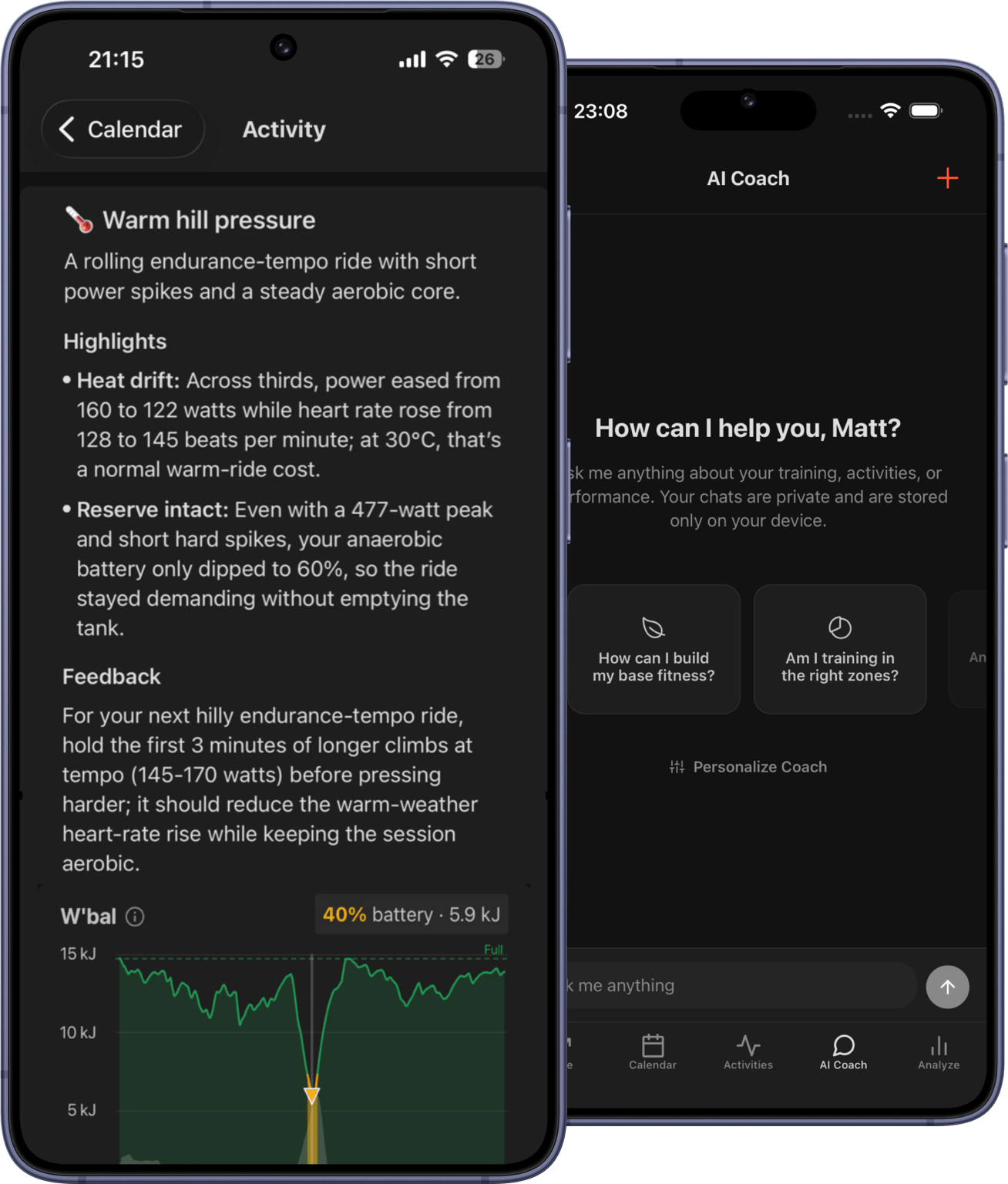
Ask FormBeat's AI Coach anything - what to ride today, why a session felt flat, how to pace your next race - and it answers from your real training: your power, your history, how you're recovering. Not generic tips, but a read of what each ride actually meant and what to do next.
The guidance you'd pay a coach for - for the price of an app.