Power Zones Calculator
Use this tool to calculate your cycling power training zones. Choose from multiple power zone calculation methods based on Functional Threshold Power (FTP) – Dr. Andrew Coggan, British Cycling, Carmichael Training Systems (CTS), USA Triathlon (USAT), Durata, 80/20 Endurance or MyProCoach.
| Power Zone | Power (Watts) |
|---|---|
Active Recovery
| – |
Aerobic Endurance
| – |
Tempo
| – |
Lactate Threshold
| – |
VO2 Max
| – |
Anaerobic Capacity
| – |
Neuromuscular power
| – |
Never set your zones manually again
Connect Strava or Garmin and FormBeat keeps your FTP and power zones current automatically, while tracking your fitness, fatigue, and form.
30-day free trial · Cancel anytime


“If you find yourself wishing there was just one simple resource you could rely on to fully explain, examine and guide your training, FormBeat could be your answer.”
 Trusted by 20,000+ cyclists
Active Recovery
“Easy spinning” or “light pedal pressure”, i.e., very low level exercise, too low in and of itself to induce significant physiological adaptations. Minimal sensation of leg effort/fatigue. Requires no concentration to maintain pace, and continuous conversation possible. Typically used for active recovery after strenuous training days (or races), between interval efforts, or for socializing.
Aerobic Endurance
“All day” pace, or classic long slow distance (LSD) training. Sensation of leg effort/fatigue generally low, but may rise periodically to higher levels (e.g., when climbing). Concentration generally required to maintain effort only at highest end of range and/or during longer training sessions. Breathing is more regular than at level 1, but continuous conversation still possible. Frequent (daily) training sessions of moderate duration (e.g., 2 h) at level 2 possible (provided dietary carbohydrate intake is adequate), but complete recovery from very long workouts may take more than 24 hs.
Tempo
Typical intensity of fartlek workout, ‘spirited’ group ride, or briskly moving paceline. More frequent/greater sensation of leg effort/fatigue than at level 2. Requires concentration to maintain alone, especially at upper end of range, to prevent effort from falling back to level 2. Breathing deeper and more rhythmic than level 2, such that any conversation must be somewhat halting, but not as difficult as at level 4. Recovery from level 3 training sessions more difficult than after level 2 workouts, but consecutive days of level 3 training still possible if duration is not excessive and dietary carbohydrate intake is adequate.
Lactate Threshold
Just below to just above TT effort, taking into account duration, current fitness, environmental conditions, etc. Essentially continuous sensation of moderate or even greater leg effort/fatigue. Continuous conversation difficult at best, due to depth/frequency of breathing. Effort sufficiently high that sustained exercise at this level is mentally very taxing – therefore typically performed in training as multiple ‘repeats’, ‘modules’, or ‘blocks’ of 10-30 min duration. Consecutive days of training at level 4 possible, but such workouts generally only performed when sufficiently rested/recovered from prior training so as to be able to maintain intensity.
VO2 Max
Typical intensity of longer (3-8 min) intervals intended to increase VO2max. Strong to severe sensations of leg effort/fatigue, such that completion of more than 30-40 min total training time is difficult at best. Conversation not possible due to often ‘ragged’ breathing. Should generally be attempted only when adequately recovered from prior training – consecutive days of level 5 work not necessarily desirable even if possible. Note: At this level, the average heart rate may not be due to slowness of heart rate response and/or ceiling imposed by maximum heart rate)
Anaerobic Capacity
Short (30 s to 3 min), high intensity intervals designed to increase anaerobic capacity. Heart rate generally not useful as guide to intensity due to non-steady-state nature of effort. Severe sensation of leg effort/fatigue, and conversation impossible. Consecutive days of extended level 6 training usually not attempted.
Neuromuscular power
Very short, very high intensity efforts (e.g., jumps, standing starts, short sprints) that generally place greater stress on musculoskeletal rather than metabolic systems. Power useful as guide, but only in reference to prior similar efforts, not TT pace.
Frequently Asked Questions
How are cycling power zones calculated? +
How many power zones are there? +
What zone should I train in? +
How do power zones change when FTP changes? +
Related Tools
All Tools →FTP Calculator
Estimate your FTP from a 20-minute, ramp, or 8-minute test and get your power zones.
Heart Rate Zones Calculator
Build 5- or 7-zone heart rate models from max HR or LTHR.
TSS Calculator
Score a ride's training stress from duration, power, and FTP.
How Good is My FTP?
Compare your FTP and W/kg against rider categories.
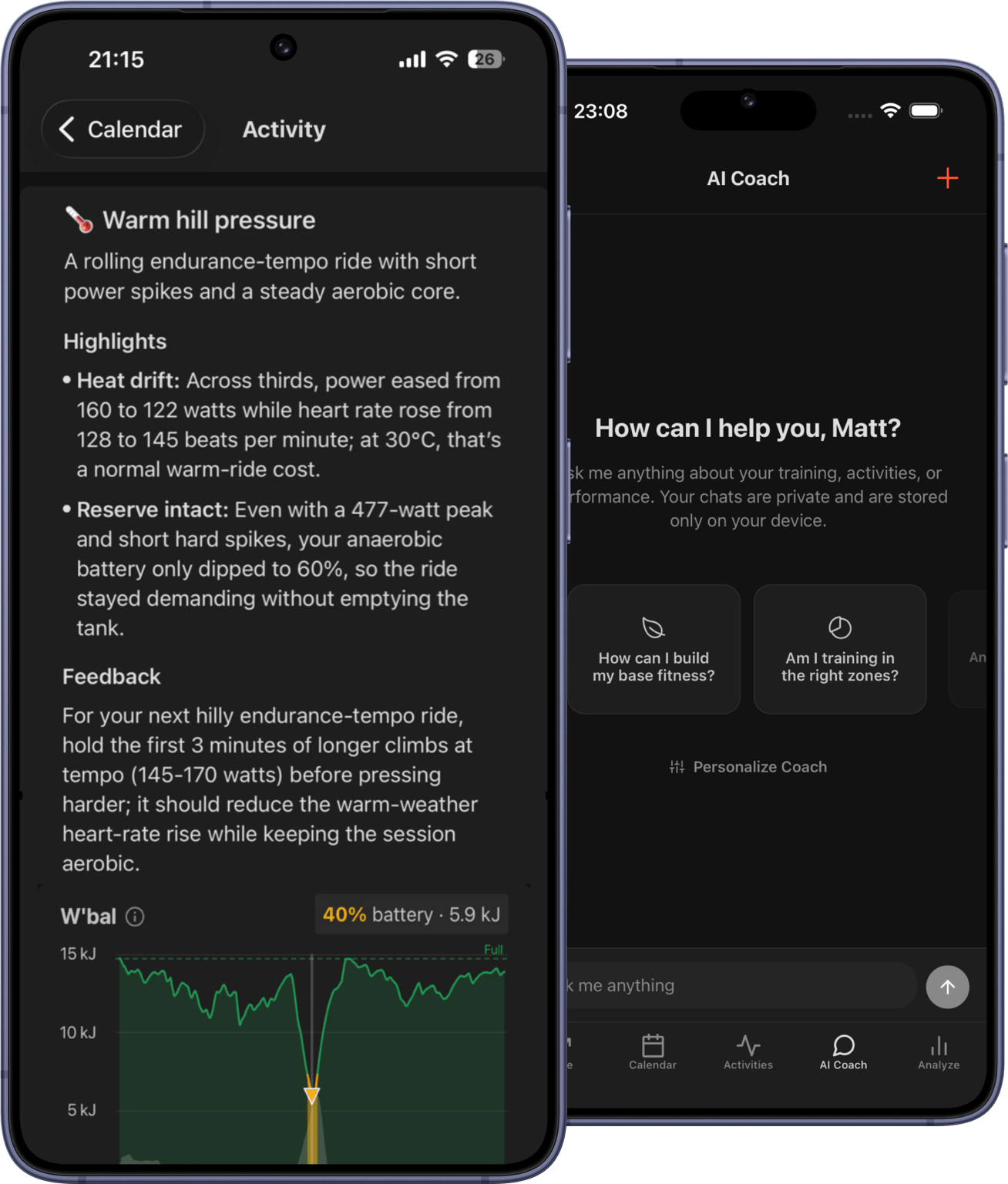
A coach who's seen every ride you've done
Ask FormBeat's AI Coach anything - what to ride today, why a session felt flat, how to pace your next race - and it answers from your real training: your power, your history, how you're recovering. Not generic tips, but a read of what each ride actually meant and what to do next.
The guidance you'd pay a coach for - for the price of an app.