Heart Rate Zones Calculator for Cycling
Calculate your heart rate training zones. Choose from multiple calculation methods based on Maximum Heart Rate or Lactate Threshold Heart Rate (LTHR) to get your 5-Zone or 7-Zone training model.
| Zone | Heart Rate (bpm) |
|---|---|
Active Recovery
| – |
Aerobic Endurance
| – |
Tempo
| – |
Lactate Threshold
| – |
VO2 Max
|
Zones that keep up with your fitness
FormBeat builds your heart rate and power zones from the rides you're already doing, tracks your training load, and tells you what to focus on each week.
30-day free trial · Cancel anytime


“If you find yourself wishing there was just one simple resource you could rely on to fully explain, examine and guide your training, FormBeat could be your answer.”
 Trusted by 20,000+ cyclists
Active Recovery
“Easy spinning” or “light pedal pressure”, i.e., very low level exercise, too low in and of itself to induce significant physiological adaptations. Minimal sensation of leg effort/fatigue. Requires no concentration to maintain pace, and continuous conversation possible. Typically used for active recovery after strenuous training days (or races), between interval efforts, or for socializing.
Aerobic Endurance
“All day” pace, or classic long slow distance (LSD) training. Sensation of leg effort/fatigue generally low, but may rise periodically to higher levels (e.g., when climbing). Concentration generally required to maintain effort only at highest end of range and/or during longer training sessions. Breathing is more regular than at level 1, but continuous conversation still possible. Frequent (daily) training sessions of moderate duration (e.g., 2 h) at level 2 possible (provided dietary carbohydrate intake is adequate), but complete recovery from very long workouts may take more than 24 hs.
Tempo
Typical intensity of fartlek workout, ‘spirited’ group ride, or briskly moving paceline. More frequent/greater sensation of leg effort/fatigue than at level 2. Requires concentration to maintain alone, especially at upper end of range, to prevent effort from falling back to level 2. Breathing deeper and more rhythmic than level 2, such that any conversation must be somewhat halting, but not as difficult as at level 4. Recovery from level 3 training sessions more difficult than after level 2 workouts, but consecutive days of level 3 training still possible if duration is not excessive and dietary carbohydrate intake is adequate.
Lactate Threshold
Just below to just above TT effort, taking into account duration, current fitness, environmental conditions, etc. Essentially continuous sensation of moderate or even greater leg effort/fatigue. Continuous conversation difficult at best, due to depth/frequency of breathing. Effort sufficiently high that sustained exercise at this level is mentally very taxing – therefore typically performed in training as multiple ‘repeats’, ‘modules’, or ‘blocks’ of 10-30 min duration. Consecutive days of training at level 4 possible, but such workouts generally only performed when sufficiently rested/recovered from prior training so as to be able to maintain intensity.
VO2 Max
Typical intensity of longer (3-8 min) intervals intended to increase VO2max. Strong to severe sensations of leg effort/fatigue, such that completion of more than 30-40 min total training time is difficult at best. Conversation not possible due to often ‘ragged’ breathing. Should generally be attempted only when adequately recovered from prior training – consecutive days of level 5 work not necessarily desirable even if possible. Note: At this level, the average heart rate may not be due to slowness of heart rate response and/or ceiling imposed by maximum heart rate)
Heart Rate Training Zones: A Complete Guide for Cyclists
Heart rate zones provide one of the most accessible and effective ways to structure your cycling training. By training at the right intensity, you can maximize fitness gains while managing fatigue and avoiding overtraining.
How Heart Rate Zones Work
Heart rate zones divide the spectrum from resting to maximum effort into distinct ranges, each producing specific physiological adaptations. Lower zones develop aerobic endurance and fat oxidation, while higher zones improve lactate tolerance and maximal oxygen consumption. The boundaries between zones represent metabolic tipping points where your body shifts between different energy systems.
The two most common approaches for setting zone boundaries are percentage of Maximum Heart Rate (MHR) and percentage of Lactate Threshold Heart Rate (LTHR). The LTHR method is generally more accurate because it accounts for individual fitness — two cyclists of the same age can have very different lactate thresholds, which the MHR method cannot capture.
Heart Rate Zone Models Compared
Coggan 5-Zone Model (% of MHR): The simplest and most widely used model. Zones are divided by percentage of maximum heart rate: Zone 1 (50-60%), Zone 2 (60-70%), Zone 3 (70-80%), Zone 4 (80-90%), and Zone 5 (90-100%). Best for beginners or those without a recent LTHR test.
Friel 5-Zone Model (% of LTHR): Uses lactate threshold as the anchor point. Zone boundaries are set relative to the heart rate at which lactate begins accumulating, providing more physiologically meaningful training targets. This model is popular with coaches and competitive cyclists.
Friel 7-Zone Model (% of LTHR): Adds granularity by splitting the upper zones into sub-threshold, super-threshold, aerobic capacity, and anaerobic capacity zones. This precision is valuable for advanced cyclists following structured periodized plans.
How to Determine Your Maximum Heart Rate
The common formula "220 minus your age" is only a rough estimate with a standard deviation of ±10-12 bpm. For accurate zone calculation, you should test your actual maximum heart rate. A simple field test: after a thorough warm-up, ride 3 progressively harder 2-minute intervals on a steep hill, with the final one as an absolute all-out sprint. Your maximum heart rate will be the highest value recorded during or immediately after the last effort.
For the LTHR method, perform a 30-minute time trial after warming up. Your average heart rate for the last 20 minutes closely approximates your lactate threshold heart rate. This value serves as the anchor for all LTHR-based zone calculations and is the recommended method for serious training.
Zone 2: The Foundation of Endurance Fitness
Zone 2 deserves special attention because it is where the majority of your training time should be spent. Riding in Zone 2 develops mitochondrial density, improves fat oxidation, builds capillary networks in working muscles, and strengthens cardiac output — all without accumulating significant fatigue. For detailed Zone 2 guidance, see our Zone 2 Training Calculator .
Heart Rate Zones vs. Power Zones
Heart rate and power zones each have strengths and limitations. Heart rate responds with a 30-60 second delay to changes in effort, making it poor for interval precision. It also drifts upward during long rides (cardiac drift) and is influenced by heat, caffeine, dehydration, and fatigue. However, heart rate is always available without additional equipment and reflects actual physiological stress.
Power meters provide instantaneous, objective measurement unaffected by external conditions, making them superior for interval training and race pacing. The ideal approach is to use both: power for prescribing and executing workout intensity, and heart rate for monitoring physiological response, detecting fatigue, and tracking aerobic fitness trends over time.
Frequently Asked Questions
How does the Heart Rate Zones Calculator work? +
What are heart rate zones and why are they important for cycling? +
How do I determine my Maximum Heart Rate (MHR)? +
What is Lactate Threshold Heart Rate (LTHR) and how do I find it? +
What's the difference between 5-zone and 7-zone heart rate training? +
How can I use these zones in my cycling training? +
What is "sweetspot" training and how does it relate to these zones? +
How often should I recalculate my zones? +
Can this calculator help prevent overtraining? +
Is this calculator suitable for both beginners and advanced cyclists? +
Remember, while this calculator is a valuable tool, it's always best to combine it with perceived effort and, if possible, power data for the most comprehensive approach to your cycling training.
Related Tools
All Tools →Lactate Threshold Calculator
Estimate your threshold heart rate and power from a field test.
Power Zones Calculator
Turn your FTP into training zones with exact watt ranges.
Zone 2 Calculator
Find your Zone 2 range for aerobic base training.
VO2 Max Calculator
Estimate your VO2 max from FTP or resting heart rate.
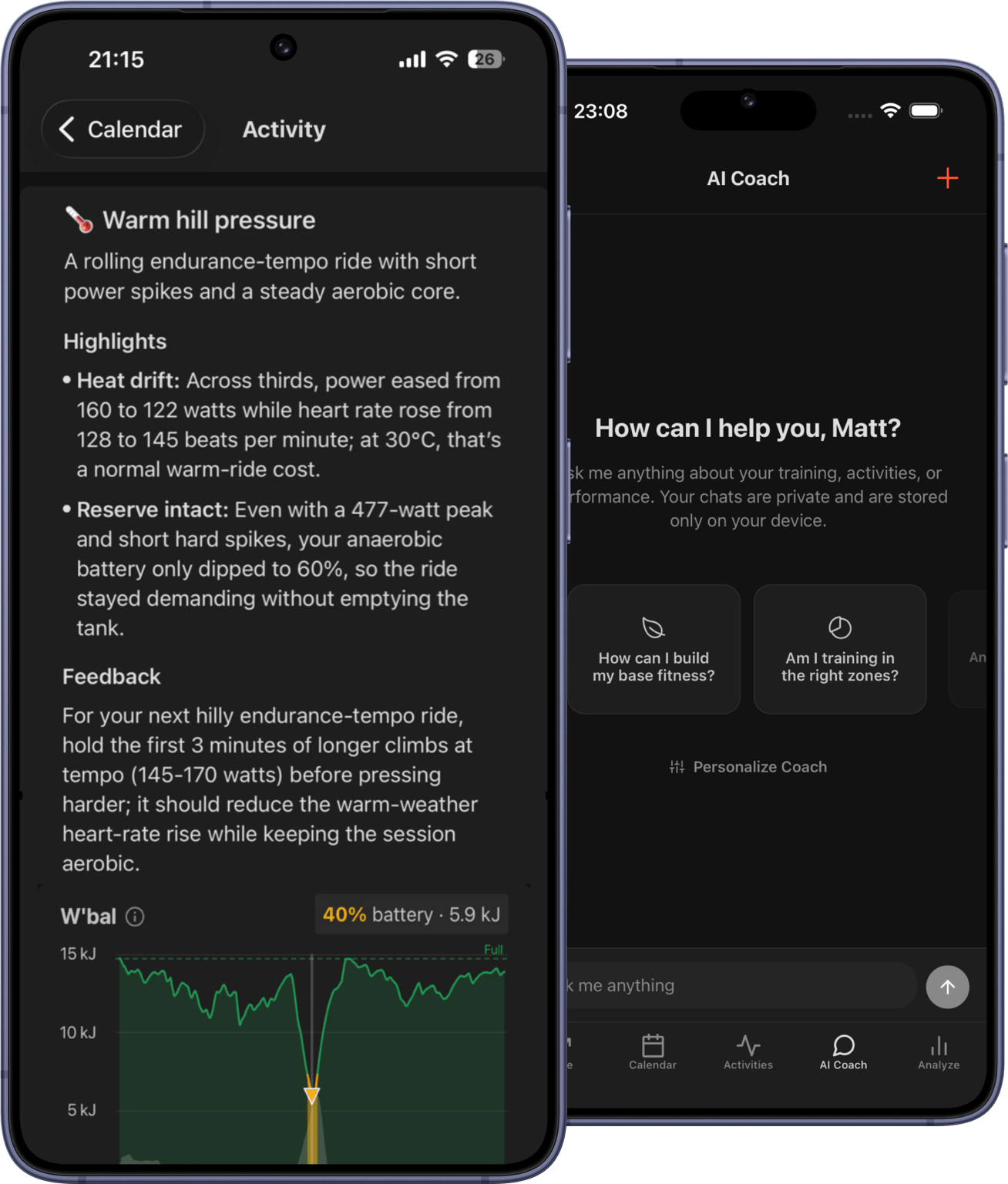
A coach who's seen every ride you've done
Ask FormBeat's AI Coach anything - what to ride today, why a session felt flat, how to pace your next race - and it answers from your real training: your power, your history, how you're recovering. Not generic tips, but a read of what each ride actually meant and what to do next.
The guidance you'd pay a coach for - for the price of an app.