Cycling Calorie Calculator
Calculate how many calories you burned on your bike ride. If you ride with a power meter, the kilojoule method is the most accurate calorie estimate available outside a lab. No power meter? Get a solid estimate from your weight, ride time, and intensity. Show more
Your rides say more than calories
FormBeat analyzes every ride automatically — training load, fitness trends, and daily guidance built from your real power and heart rate data.
30-day free trial · Cancel anytime


“If you find yourself wishing there was just one simple resource you could rely on to fully explain, examine and guide your training, FormBeat could be your answer.”
 Trusted by 20,000+ cyclists
How Many Calories Does Cycling Burn?
Cycling burns anywhere from 300 to over 1,000 calories per hour depending on your weight, speed, and terrain. That huge range is exactly why generic estimates fail — and why riders with power meters have a massive accuracy advantage.
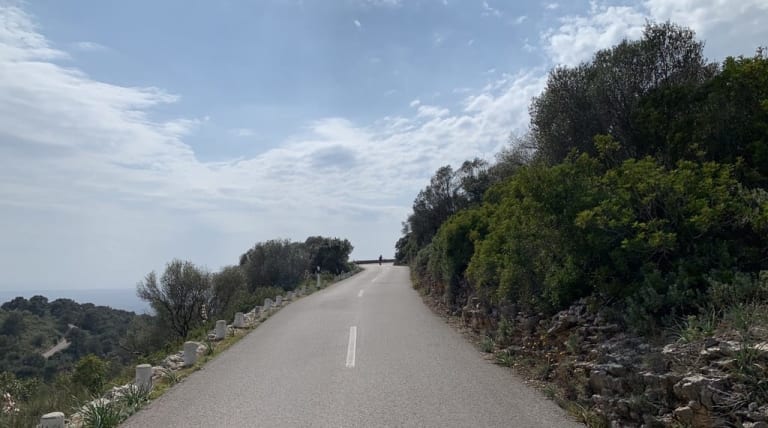
What Determines Your Calorie Burn
A typical recreational ride at 15-18 km/h burns around 400-500 kcal per hour for a 75 kg rider. Push the pace into fast group-ride territory and that climbs to 750-900 kcal per hour. Racing efforts can exceed 1,100 kcal per hour. Your body weight scales these numbers almost linearly — a 90 kg rider burns roughly 50% more than a 60 kg rider at the same relative effort, because moving more mass takes more energy.
The catch: speed alone is a poor proxy for effort. Twenty-five km/h into a headwind is a hard workout; 25 km/h in a draft is recovery pace. That's why the most accurate method doesn't use speed at all — it uses power.
Why Power Data Beats Every Other Method
A power meter measures the mechanical work you actually produce, in kilojoules (kJ). Unlike heart rate, GPS speed, or motion-sensor estimates, work is a direct physical measurement — there's nothing to guess. If your head unit says you did 800 kJ, you did 800 kJ, whether it was windy, hilly, hot, or you were having a bad day.
Converting kilojoules to calories burned involves a happy coincidence of physiology. One kilocalorie equals 4.184 kilojoules, so 800 kJ of work "costs" only about 191 kcal of mechanical energy. But the human body is not a perfect engine — gross metabolic efficiency on a bike is roughly 20-25%, meaning you burn four to five calories of food energy for every calorie of work delivered to the pedals. Multiply it out and the conversion factor lands almost exactly at 1: at 24% efficiency, 800 kJ of work burns about 800 kcal. That's why coaches and sports scientists simply read kJ as kcal.
The honest error bars: if your true efficiency is 25%, the same 800 kJ ride burned about 765 kcal; at 20% efficiency, about 955 kcal. Even at the extremes, that's far tighter than fitness-tracker estimates, which routinely miss by 30-50% on cycling. If you train with power and want to put those kilojoules in context, knowing your FTP tells you how hard each ride actually was relative to your ability.
Calories Burned Cycling by Speed and Weight
No power meter? Use the table below. It's built from MET values in the Compendium of Physical Activities — the standard reference used in exercise research. Find your weight row and the column closest to your average speed for an estimated hourly burn.
| Weight | <16 km/h (easy) | 16–19 km/h | 19–22 km/h | 22–26 km/h | 26–30 km/h | 32+ km/h |
|---|---|---|---|---|---|---|
| 60 kg | 240 | 408 | 480 | 600 | 720 | 948 |
| 70 kg | 280 | 476 | 560 | 700 | 840 | 1,106 |
| 80 kg | 320 | 544 | 640 | 800 | 960 | 1,264 |
| 90 kg | 360 | 612 | 720 | 900 | 1,080 | 1,422 |
All values are kcal per hour. Mountain biking averages around 8.5 METs — similar to the 19-22 km/h road column despite the lower speeds.
What Affects Calorie Burn on the Bike
Body weight is the biggest multiplier. Every watt of climbing and every acceleration costs energy proportional to mass, which is why heavier riders burn substantially more calories at the same speed.
Speed and drafting interact dramatically. Aerodynamic drag grows with the square of speed, so riding 32 km/h solo takes nearly double the power of riding 25 km/h. But sit in a group and drafting cuts your energy cost by 25-40% — a fast group ride can burn fewer calories than a slower solo effort.
Terrain and wind are why distance-based estimates fail. A hilly 50 km with 1,000 m of climbing burns far more than a flat 50 km, and a steady headwind can add hundreds of calories to the same route. Power-based calculation captures all of this automatically.
Fitness changes the equation in a subtle way: a fitter rider burns roughly the same calories per kilojoule of work, but can sustain far more work per hour. As your fitness grows, your hourly burn capacity grows with it — one reason trained cyclists can eat impressively and stay lean.
Cycling for Weight Loss
Weight loss comes down to a sustained energy deficit, and cycling is one of the best tools for creating one: it's low-impact, scalable from 30-minute spins to 5-hour epics, and genuinely enjoyable enough to repeat — which matters more than any single workout. A deficit of roughly 7,700 kcal corresponds to one kilogram of body fat, so three 600 kcal rides per week is a meaningful contribution without touching your diet.
The most effective fat-burning intensity is also the most sustainable one. Zone 2 riding maximizes the proportion of energy drawn from fat, builds the aerobic engine that lets you ride longer, and leaves you fresh enough to ride again tomorrow. Save the intervals for fitness; build the deficit with volume.
One critical caveat: don't under-fuel long rides in the name of weight loss. Riding two-plus hours on empty leads to bonking, wrecked workouts, and rebound overeating. Fuel the work, and create your deficit across the whole day instead. Consistent moderate deficits beat heroic starvation rides every time.
Common Mistakes When Counting Cycling Calories
Trusting generic app estimates. Apps without power data estimate from speed and GPS, which ignores wind, drafting, and terrain. Errors of 30-50% are common — almost always overestimates on flat group rides and underestimates on hilly solo ones.
Double-counting with fitness trackers. If your watch adds ride calories on top of an inflated daily "active calories" number, you can easily count the same energy twice. Pick one source of truth — ideally your power meter's kJ — and ignore the rest.
Eating back every calorie. Calorie estimates have error bars, and the human instinct is to round rewards up. If weight loss is the goal, eat back only part of what you burned and let the weekly trend on the scale be the referee.
Confusing calories with training stress. A 700 kcal coffee ride and a 700 kcal interval session are completely different workouts. Calories measure energy; they say nothing about adaptation. For that you want Training Stress Score (TSS) , which weighs intensity as well as duration.
Frequently Asked Questions
How accurate are cycling calorie calculators? +
Why does my bike computer show kJ, and is that the same as calories? +
How many calories does a 1-hour bike ride burn? +
Does cycling burn more calories than running? +
How many calories do I burn cycling 10 miles? +
Should I eat back the calories I burn cycling? +
Do calories burned depend on which gear or cadence I use? +
See the full picture of every ride
FormBeat turns your rides into training intelligence — energy, intensity, training load, and fitness trends, analyzed automatically.
30-day free trial · Cancel anytime
“If you find yourself wishing there was just one simple resource you could rely on to fully explain, examine and guide your training, FormBeat could be your answer.”
Trusted by 20,000+ cyclistsRelated Tools
All Tools →FTP Calculator
Estimate your FTP from a 20-minute, ramp, or 8-minute test and get your power zones.
Power Zones Calculator
Turn your FTP into training zones with exact watt ranges.
TSS Calculator
Score a ride's training stress from duration, power, and FTP.
Power to Weight Calculator
Calculate your W/kg — the number that matters when the road tilts up.
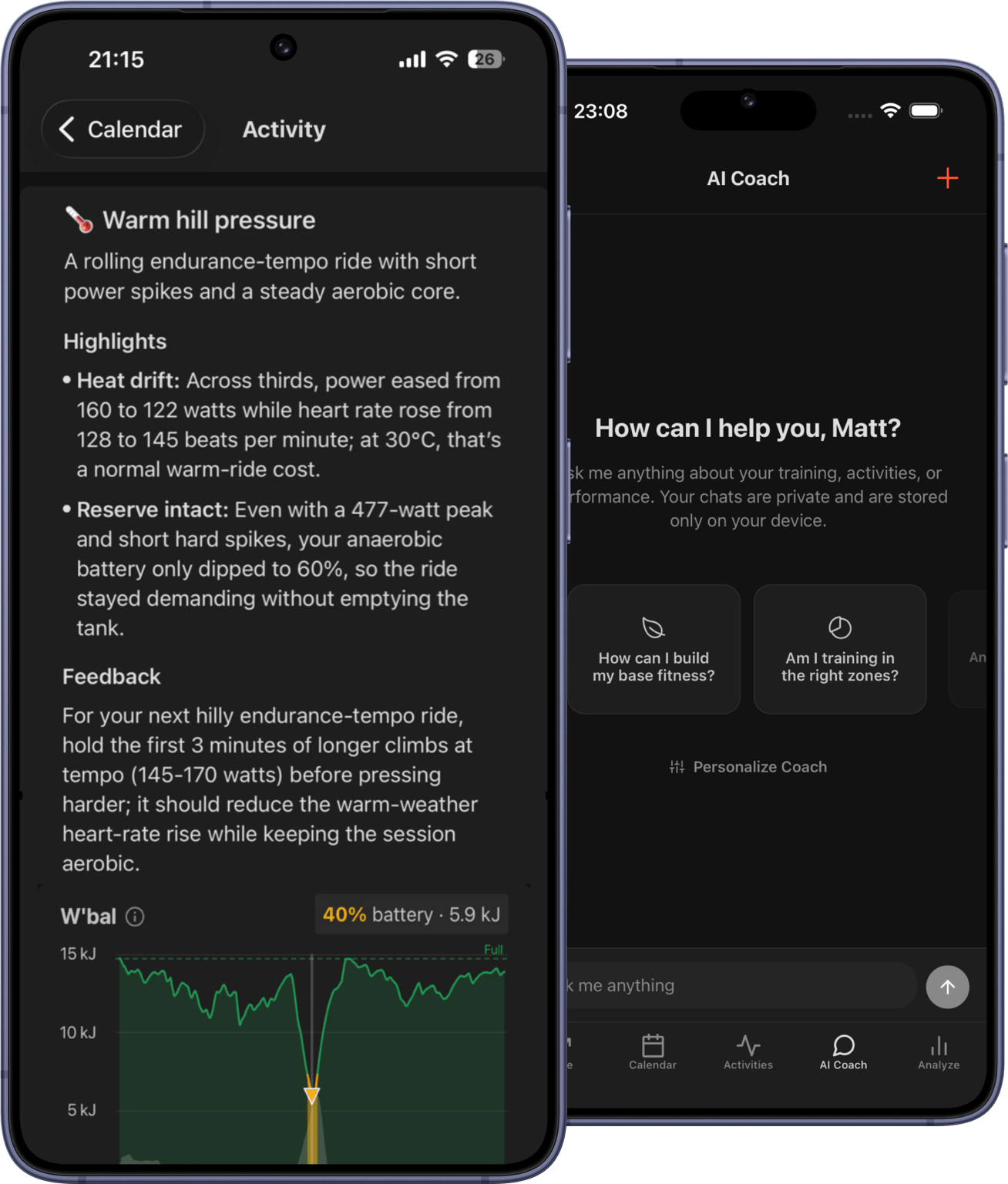
A coach who's seen every ride you've done
Ask FormBeat's AI Coach anything - what to ride today, why a session felt flat, how to pace your next race - and it answers from your real training: your power, your history, how you're recovering. Not generic tips, but a read of what each ride actually meant and what to do next.
The guidance you'd pay a coach for - for the price of an app.