Power to Weight Ratio Calculator
Calculate your watts per kilogram (W/kg) — the number that decides who reaches the top of the climb first. Enter your power in watts and your weight in kilograms or pounds.
Track your W/kg without spreadsheets
FormBeat detects FTP changes from your rides, pairs them with your weight history, and shows your power-to-weight trend over time.
30-day free trial · Cancel anytime


“If you find yourself wishing there was just one simple resource you could rely on to fully explain, examine and guide your training, FormBeat could be your answer.”
 Trusted by 20,000+ cyclists
Last updated:
Watts per Kg: The Number That Matters When the Road Tilts Up
Two riders, same wattage, different weights — on a climb, the lighter one rides away. Power-to-weight ratio explains why, and it is the single most useful way to compare cyclists of different sizes.
What Is Power-to-Weight Ratio?
Power-to-weight ratio is simply your power output divided by your body weight, expressed in watts per kilogram. A 75 kg rider holding 250 watts produces 3.33 W/kg. The same 250 watts from a 60 kg rider is 4.17 W/kg — and on a mountain pass, that difference is decisive.
The physics is straightforward. On flat roads, most of your power goes into pushing air out of the way, so absolute watts and aerodynamics dominate — a bigger, more powerful rider often wins. The moment the road climbs, gravity takes over: you are lifting your body weight (plus bike) against it, and the energy cost scales directly with mass. That is why watts per kilogram, not raw watts, predicts climbing speed, and why it is the metric coaches, racers, and virtual platforms like Zwift use to compare riders.
The most meaningful version of the metric is FTP per kilogram — your sustainable threshold power divided by weight — because it reflects what you can actually hold on a long climb rather than a brief surge.
W/kg Benchmarks by Rider Category
So what counts as a good power-to-weight ratio? The table below shows typical FTP W/kg ranges by rider level. Women's values run roughly 10-15% lower at each level due to physiological differences in muscle mass — the categories represent equivalent ability.
| Rider category | Men (FTP W/kg) | Women (FTP W/kg) |
|---|---|---|
| Untrained | 1.5 – 2.5 | 1.3 – 2.2 |
| Fair | 2.5 – 3.0 | 2.2 – 2.7 |
| Good amateur | 3.0 – 3.7 | 2.7 – 3.2 |
| Cat 3-4 racer | 3.7 – 4.2 | 3.2 – 3.7 |
| Cat 1-2 racer | 4.2 – 4.7 | 3.7 – 4.2 |
| Domestic pro | 4.7 – 5.5 | 4.2 – 4.9 |
| World class | 5.5 – 6.5+ | 4.9 – 5.8+ |
Most cyclists who train consistently for a year or two land between 3.0 and 3.7 W/kg. Crossing 4.0 W/kg puts you in genuinely competitive amateur territory. For a more detailed comparison against racing categories and elite riders, try our How Good Is My FTP tool.
Watts per Kg at Different Durations
W/kg means something different at every duration, and together those numbers form your power profile. Five-second W/kg measures sprint power — track sprinters can exceed 20 W/kg in a finish kick. One-minute power reflects anaerobic capacity, the engine behind attacks and short, steep ramps. Five-minute W/kg tracks closely with VO2 max — your aerobic ceiling — while 20-minute and FTP W/kg measure the sustained threshold power that decides long climbs and time trials.
Comparing your W/kg across durations reveals your rider type. A sprinter shows huge short-duration numbers that fall away quickly; a climber or time trialist holds a flatter curve with strong 20-minute and threshold values. Neither profile is better — but knowing yours tells you which races suit you and which energy systems need work.
How to Improve Your Power-to-Weight Ratio
The ratio has two levers: raise the numerator or lower the denominator. For most riders, raising power is the better first move. Structured training — a large aerobic base topped with sweetspot and threshold intervals in the right power zones — can lift FTP by 5-15% in a season. Use our FTP calculator to baseline your threshold, then retest every 6-8 weeks.
Weight loss works too, but it is the riskier lever. Losing weight faster than about 0.5 kg per week tends to cost muscle and power, so your W/kg can stagnate or even fall while the scale drops — the classic trap of chasing lightness at the expense of the engine. Aim for gradual changes in body composition during base season, never during peak training blocks, and prioritize fueling your key workouts.
The math helps set expectations: a 75 kg rider with a 250 W FTP gains the same W/kg from adding 8 watts as from losing 2.4 kg. Early on, the watts are much easier to find. As you approach your genetic power ceiling, returns diminish and body composition becomes relatively more important — which is exactly why elite climbers obsess over both.
When Absolute Power Beats W/kg
Watts per kilogram is not the whole story. On flat roads, in time trials, and in criteriums, aerodynamic drag — not gravity — is the main resistance, and drag does not scale proportionally with weight. A 85 kg rider pushing 320 W will almost always out-pace a 60 kg rider pushing 250 W on the flat, despite a lower W/kg. Raw watts also win in sprints, echelons, and anywhere momentum and draft matter.
So don't over-index on one number. If you race flat crits, absolute power and watts per CdA matter more than climbing ratios. If your goals point uphill — gran fondos, hill climbs, mountainous road races — W/kg is your headline metric. The best riders track both, and watch the trend over months rather than any single test.
Frequently Asked Questions
What is a good power-to-weight ratio for cycling? +
What W/kg do pro cyclists average? +
How do I calculate watts per kg? +
Is 3.5 W/kg good? +
Should I lose weight or gain power? +
Does W/kg matter on flat roads? +
Are watts per kilo, W/kg, and watts per kilogram the same thing? +
Related Tools
All Tools →FTP Calculator
Estimate your FTP from a 20-minute, ramp, or 8-minute test and get your power zones.
How Good is My FTP?
Compare your FTP and W/kg against rider categories.
VO2 Max Calculator
Estimate your VO2 max from FTP or resting heart rate.
Critical Power Calculator
Model your critical power and W′ from two or three maximal efforts.
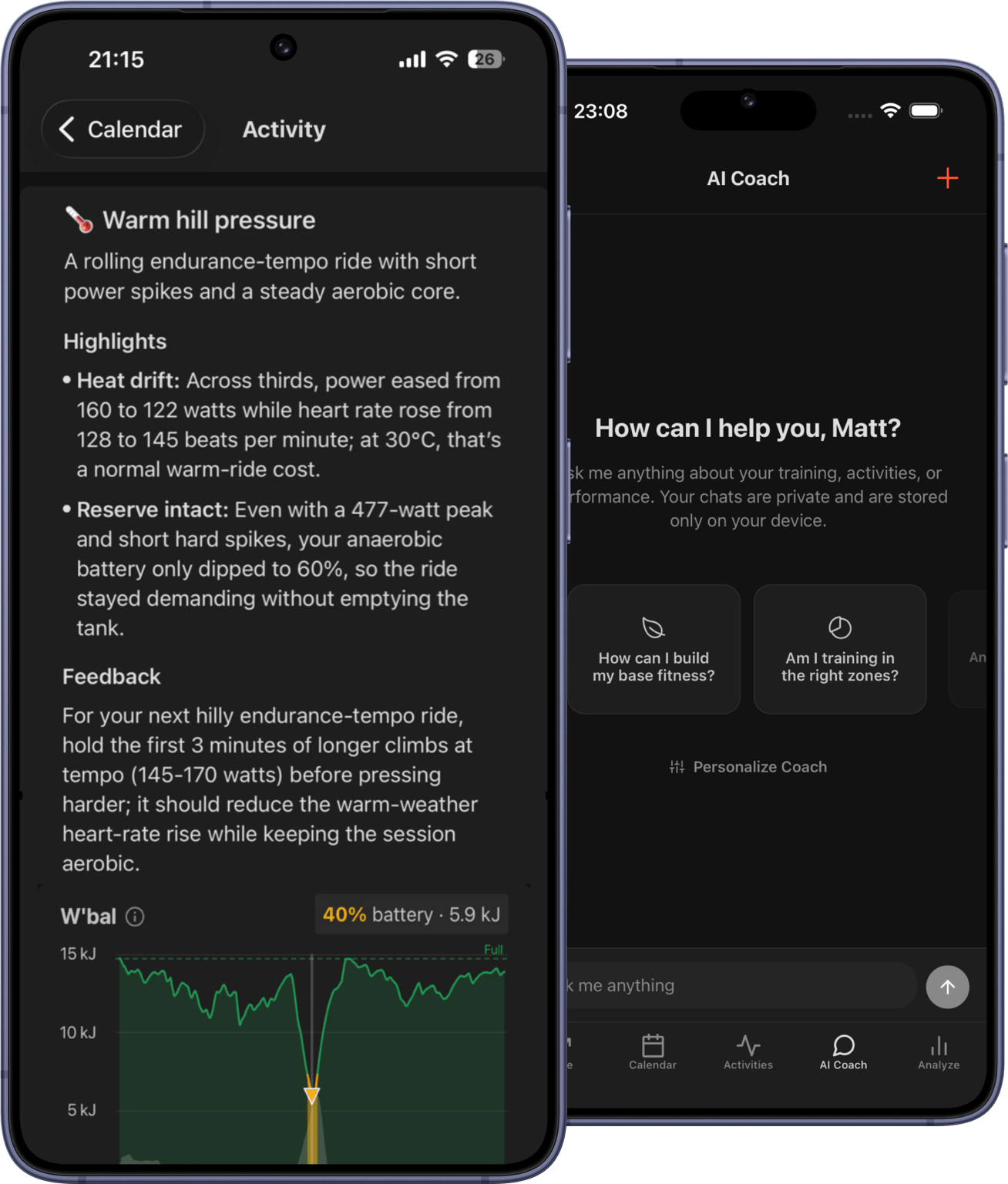
A coach who's seen every ride you've done
Ask FormBeat's AI Coach anything - what to ride today, why a session felt flat, how to pace your next race - and it answers from your real training: your power, your history, how you're recovering. Not generic tips, but a read of what each ride actually meant and what to do next.
The guidance you'd pay a coach for - for the price of an app.