Critical Power (CP) Calculator
Critical Power (CP) is the highest power you can sustain without dipping into your reserves. Below CP, your body stays in balance — you can keep going. Above it, you start draining your Available Work Capacity (W') like a battery slowly emptying. The harder you go above CP, the faster it drains. When it's empty, you're forced to ease off and recover. Show more
Enter at least 3 maximal efforts of different durations. The recommended protocol is 3 min, 5 min, and 12 min all-out efforts — performed on separate days or with full recovery between them.
See your full power curve
FormBeat analyzes your ride history to map your power from 1 second to 2 hours, identifies your rider type, and shows you what to train next.
30-day free trial · Cancel anytime


“If you find yourself wishing there was just one simple resource you could rely on to fully explain, examine and guide your training, FormBeat could be your answer.”
 Trusted by 20,000+ cyclists
What Critical Power Actually Tells You
Most cyclists know their FTP. Fewer know their Critical Power — but it answers questions FTP can't, like "can I hold 320W for the 6-minute climb to the finish?" or "how many hard surges do I have left?"
What is Critical Power (CP)?
In cycling, Critical Power is the boundary between sustainable and unsustainable effort. Below CP, your body stays in equilibrium — effort is sustainable. Above it, you're spending from a finite reserve of work — your Available Work Capacity (W'). Every watt above CP drains that reserve. Push 20W over and it drains slowly. Push 100W over and it empties fast. When it's gone, you have to drop back to CP or below to recover. For most cyclists, CP corresponds to roughly 30-40 minutes of maximal sustainable power, making it 3-8% higher than FTP (which targets ~60 minutes).
Example: A rider with a CP of 260W and an Available Work Capacity of 20 kJ can hold 280W for about 16 minutes before the reserve runs out. At 310W — 50W over — that same reserve lasts just 6 minutes and 40 seconds. Same tank, different burn rate.
What is Available Work Capacity (W')?
Your Available Work Capacity (W') is the total amount of work — measured in kilojoules — that you can perform above CP before you're empty. Once it's gone, you're forced back down to CP or below to recover.
The key insight: it doesn't matter how you spend your Available Work Capacity. A 3-minute all-out effort and six 30-second surges drain the same tank. If your W' is 20 kJ and you ride at 50W above CP, you have exactly 400 seconds (20,000J ÷ 50W) before you crack. At 100W above CP, you have 200 seconds — half the time, same total energy.
Typical values: recreational cyclists 8-15 kJ, trained road riders 15-25 kJ, track sprinters 25-35 kJ. Your Available Work Capacity reflects your anaerobic capacity — it's trainable, but it's also partly genetic. Riders with a large W' can follow attacks, sprint out of corners, and surge over short hills. Riders with a small W' are better served by time-trialling the race from the front.
What is Pmax (Peak Power)?
Pmax is the model's estimate of your maximum instantaneous power — the theoretical ceiling of your power-duration curve as effort duration approaches zero. It represents the upper limit of what your neuromuscular system can produce.
Unlike a 1-second sprint test (which measures actual peak power), Pmax is extrapolated from your longer efforts. It's most useful as a reference point: it completes the picture of your power profile from sprint to endurance. A climber with CP of 280W might have a Pmax of 900W, while a sprinter with the same CP might show 1400W — same endurance engine, very different top-end.
When 320 FTP ≠ 320 FTP
Two riders show up to the same race. Both have an FTP of 320W. On paper, they're identical. In practice, they're completely different riders — and the CP model explains why.
Rider A: CP 335W, Available Work Capacity 14 kJ. A diesel engine. His critical power is high relative to his FTP, but his anaerobic tank is small. He's devastating on 20-minute climbs and time trials, but he can only follow one or two hard attacks before he's empty.
Rider B: CP 330W, Available Work Capacity 26 kJ. An explosive all-rounder. Slightly lower CP, but nearly double the work capacity. He can follow five attacks in the final 10km, sprint out of every corner, and still have enough to contest the finish.
At 380W (about 50W above both riders' CP), Rider A lasts 5m 11s . Rider B lasts 8m 40s — 1.7× longer, from the same "FTP."
FTP told you they were equal. CP and Available Work Capacity tell you they'll race completely differently — and need different strategies to win. Rider A should control the pace and avoid surges. Rider B should attack repeatedly and force Rider A to spend their reserve.
The Math Behind the Curve
Every cyclist has a power-duration curve: the harder you go, the shorter you last. Critical Power modeling fits a mathematical curve to your best efforts and extracts two values from it — CP and your Available Work Capacity (W').
The model is simple: Time to exhaustion = W' ÷ (Power − CP) . That's it. For any power above CP, this equation predicts exactly how long you can sustain it. Flip it around and you get Power = CP + W' ÷ Time — the maximum power you can average over any given duration.
The elegance is that from just a few all-out efforts, you get predictions across the entire power-duration spectrum. No need for a separate test at every duration — three good efforts define the whole curve.
CP-Based Training Zones
Most cyclists train with FTP-based zones — typically 5 or 6 zones where Zone 4 (threshold) sits around 91-105% of FTP. CP-based zones use 7 zones anchored to Critical Power instead. Since CP is a physiologically measured boundary (not an estimate from a 20-minute test), the zones align more precisely with what's actually happening in your body.
The key difference is at threshold. FTP zones place the threshold boundary at an estimated value — 95% of your 20-minute power, or whatever protocol you used. CP zones place it at the exact power where your physiology shifts from sustainable to time-limited. Above CP (Zone 5+), every watt costs Available Work Capacity — and the model can tell you exactly how much.
For endurance and tempo work (Zones 1-3), the practical difference between FTP and CP zones is small. But for threshold intervals and above, CP zones give you a more accurate target. If your FTP underestimates your true threshold by 10W, every threshold interval you do is slightly too easy — and that compounds over months of training.
CP Tracking in Formbeat
You don't need dedicated testing protocols to benefit from Critical Power. Formbeat automatically builds your power-duration curve from every ride you upload — and estimates FTP from your Critical Power. Instead of relying on a single 20-minute test, your FTP is derived from the mathematical relationship across all your best efforts.
This means your CP and estimated FTP update continuously as you ride and race. Set a new 5-minute best on a group ride? Your curve shifts. Nail a hard 12-minute climb? The model recalculates. No special tests, no dedicated FTP days — just ride hard sometimes and the data takes care of itself.
Testing Tips
The calculator uses three or more all-out efforts to fit the model. The recommended protocol is 3 min, 5 min, and 12 min , each performed fresh (separate days or with at least 30 minutes of easy riding between them).
The most common mistake is uneven pacing — starting too hard and fading produces unreliable results. Aim for the highest average power you can maintain for the entire duration. If your R² is below 0.95, one of your efforts was likely not maximal or not well-paced.
You don't need dedicated tests — recent race efforts or hard interval sessions work just as well. Use your best 3-minute power from that crit last month and your 12-minute power from Sunday's group ride.
Frequently Asked Questions
What is the difference between CP and FTP? +
Do I need to replace my FTP with CP? +
How many efforts do I need? +
What does Available Work Capacity (W') tell me about my riding? +
How accurate is the CP model? +
How are CP training zones different from FTP zones? +
How often should I retest? +
Related Tools
All Tools →FTP Calculator
Estimate your FTP from a 20-minute, ramp, or 8-minute test and get your power zones.
Power Zones Calculator
Turn your FTP into training zones with exact watt ranges.
VO2 Max Calculator
Estimate your VO2 max from FTP or resting heart rate.
How Good is My FTP?
Compare your FTP and W/kg against rider categories.
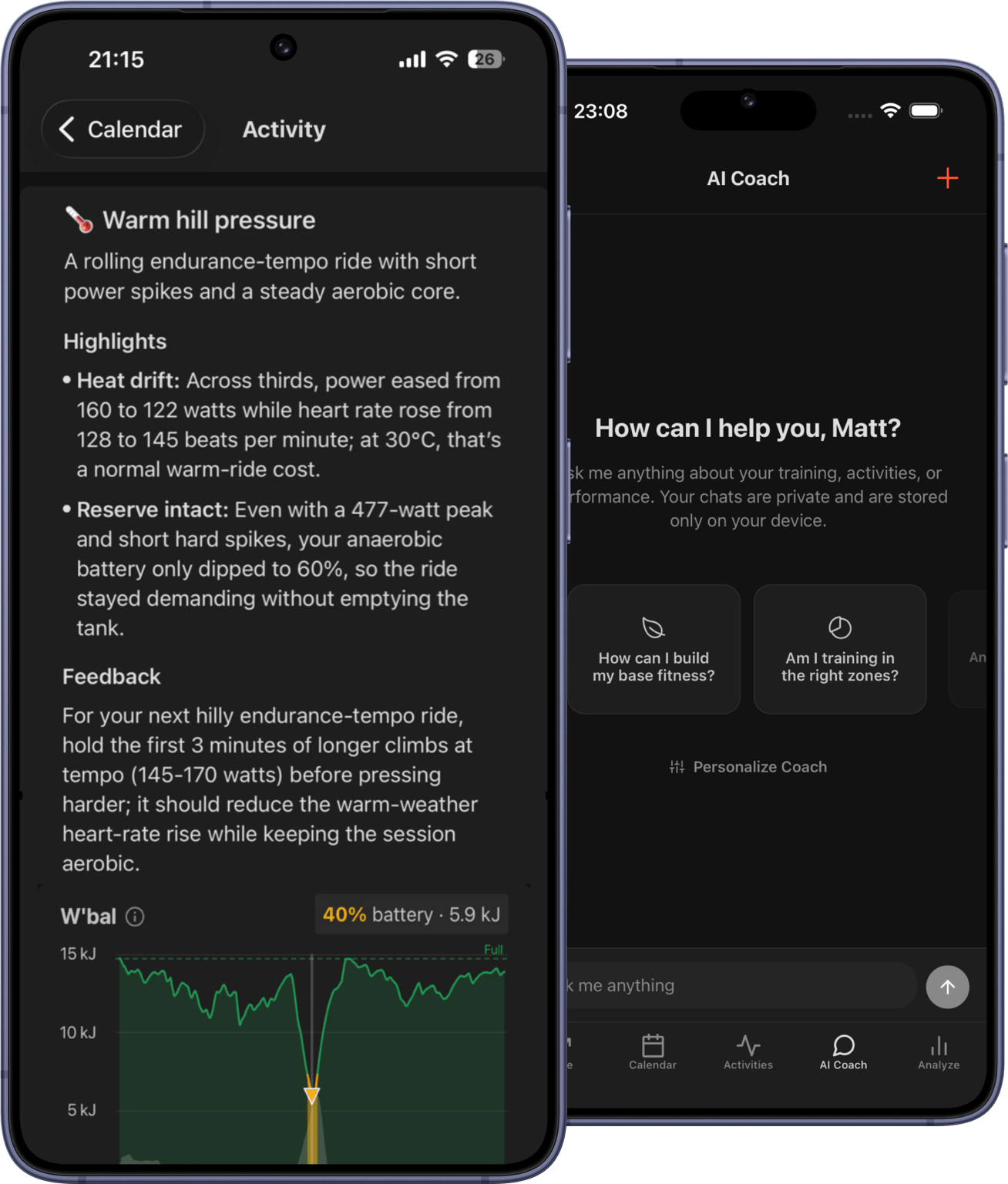
A coach who's seen every ride you've done
Ask FormBeat's AI Coach anything - what to ride today, why a session felt flat, how to pace your next race - and it answers from your real training: your power, your history, how you're recovering. Not generic tips, but a read of what each ride actually meant and what to do next.
The guidance you'd pay a coach for - for the price of an app.