Race Time Predictor
Predict your finish time for 5K, 10K, half marathon, and marathon from any recent race result. The predictor uses two proven models — the Riegel formula and the VDOT method from Jack Daniels' Running Formula — and shows your target pace per kilometer and per mile for every distance.
Know your race shape before race day
FormBeat tracks your fitness, fatigue, and form from every workout, so you arrive at the start line knowing exactly what you're capable of.
30-day free trial · Cancel anytime


“If you find yourself wishing there was just one simple resource you could rely on to fully explain, examine and guide your training, FormBeat could be your answer.”
 Trusted by 20,000+ cyclists
How Race Time Prediction Works
Every race time predictor relies on the same physiological truth: the pace you can sustain decays in a predictable way as distance increases. If we know how fast you ran one race, we can estimate how fast you should run another — provided you are trained for it. This page uses the two most trusted models in running, side by side, so you can sanity-check one against the other.
The Riegel Formula and the Meaning of 1.06
In 1977, engineer and runner Peter Riegel published a deceptively simple endurance equation: T2 = T1 × (D2/D1)^1.06. Take your known race time (T1) and distance (D1), and the formula scales it to a new distance (D2). The magic is in the exponent. If pace were constant across distances, the exponent would be exactly 1.0 — doubling the distance would simply double the time. The extra 0.06 captures fatigue: every time you double the race distance, your pace slows by roughly 4-5%.
Riegel derived 1.06 from world-class and well-trained club runners, and for that population it holds up remarkably well between about 3.5 minutes and 4 hours of racing. A 20:00 5K runner is predicted to run a 10K in about 41:40 — not 40:00 — because the longer race must be run at a slightly lower fraction of maximal aerobic capacity. The formula's elegance is that one number describes this decay across the entire endurance range.
VDOT and the Daniels Method
The second model comes from legendary coach Jack Daniels and researcher Jimmy Gilbert. Rather than scaling one time to another directly, the VDOT method first converts your race into a fitness score. It estimates the oxygen cost of your race velocity, then divides by the percentage of VO2 max a runner can sustain for that race duration. The result — your VDOT — is a "pseudo VO2 max" that reflects not just your aerobic engine but also your running economy, which is why two runners with identical lab-tested VO2 max can have different VDOTs. If you want to estimate the underlying physiological value, try our VO2 max calculator as a comparison.
Once your VDOT is known, predicting another race is a matter of finding the finish time at the new distance that corresponds to the same VDOT. Because the model is built on curves of sustainable intensity versus duration, it tends to be slightly more conservative than Riegel at the marathon — which, as you'll see below, is usually a feature rather than a bug.
Why Your Marathon Prediction Is Probably Too Fast
Ask any group of marathoners and you'll hear the same story: the 5K-based prediction was minutes faster than what happened on race day. There are good reasons for this. First is the endurance deficit — Riegel's 1.06 assumes you are as well trained for the marathon as you were for the shorter race. Most recreational runners are not. Research on lower-mileage runners suggests their personal exponent is closer to 1.07-1.10, which adds 10-20+ minutes to a marathon prediction. The fewer weekly miles you run, the more the standard formula flatters you.
Second is fueling . Races up to the half marathon are run largely on stored glycogen. The marathon is not — most runners deplete their stores somewhere between 90 and 120 minutes of hard running, and if carbohydrate intake hasn't been practiced in training, the final 10K becomes damage control rather than racing. No prediction formula can model a fueling failure. Treat marathon predictions from short races as a ceiling, not a target, and prefer a recent half marathon as the input when you're planning a marathon pace.
How to Use Predictions to Set Training Paces
The most valuable everyday use of a race predictor isn't the race itself — it's calibrating training. Your predicted times define realistic intensity anchors: easy runs should feel comfortable at 60-90 seconds per mile slower than predicted marathon pace, threshold (tempo) runs sit close to the pace you could race for about an hour, and interval work at 3K-5K effort develops your aerobic ceiling. Training at paces your current fitness supports — rather than paces you wish you had — is one of the most reliable ways to avoid injury and overreaching.
Once you have a goal race and a predicted time, use our running pace calculator to break it into per-mile and per-kilometer splits and build a pacing plan. Going out even or slightly negative is consistently associated with faster finish times than banking time early.
How to Improve Your Predicted Times
Build your aerobic base. The single biggest lever for distance running performance is the volume of easy aerobic running you absorb over months and years. Most of that should happen in Zone 2 — a conversational intensity that drives mitochondrial density, capillarization, and fat oxidation without accumulating fatigue. Runners who shortcut the base and live in the "moderately hard" middle tend to plateau, and their long-distance predictions drift further from reality.
Add threshold work. Once the base is established, regular threshold sessions — 20-40 minutes of cumulative running at roughly one-hour race effort, either continuous or as cruise intervals — raise the pace you can hold before fatigue accelerates. Threshold improvement moves every prediction in the table at once, because it shifts the entire pace-duration curve upward. Sprinkle in VO2 max intervals during sharpening phases, race a tune-up event to refresh your VDOT, and re-run the predictor every 6-8 weeks to watch the numbers come down.
Limitations of Race Time Predictors
All predictions here assume comparable conditions. A hilly or trail course can add several minutes that no formula sees. Heat and humidity slow marathon times measurably — performances degrade noticeably above roughly 15°C (59°F) wet-bulb conditions. Wind, altitude, crowded starts, and race-day execution (pacing discipline, fueling, even a missed water stop) all add variance. And the input matters: a race from two years ago describes a different runner. Use a recent, honest, all-out effort on an accurate course, treat the two models as a realistic range rather than a promise, and let your training — not the calculator — earn the number.
Frequently Asked Questions
How accurate are race time predictors? +
What is the Riegel formula? +
What is VDOT? +
Can I predict my marathon time from a 5K? +
Why is my actual marathon slower than predicted? +
How recent should the race I use be? +
Training guidance built on your real data
FormBeat analyzes every workout automatically and gives you daily training guidance — fitness trends, training load, and readiness.
30-day free trial · Cancel anytime
“If you find yourself wishing there was just one simple resource you could rely on to fully explain, examine and guide your training, FormBeat could be your answer.”
Trusted by 20,000+ cyclistsRelated Tools
All Tools →Running Pace Calculator
Convert race goals into target paces and estimated finish times.
VO2 Max Calculator
Estimate your VO2 max from FTP or resting heart rate.
Heart Rate Zones Calculator
Build 5- or 7-zone heart rate models from max HR or LTHR.
Lactate Threshold Calculator
Estimate your threshold heart rate and power from a field test.
A coach who's seen every ride you've done
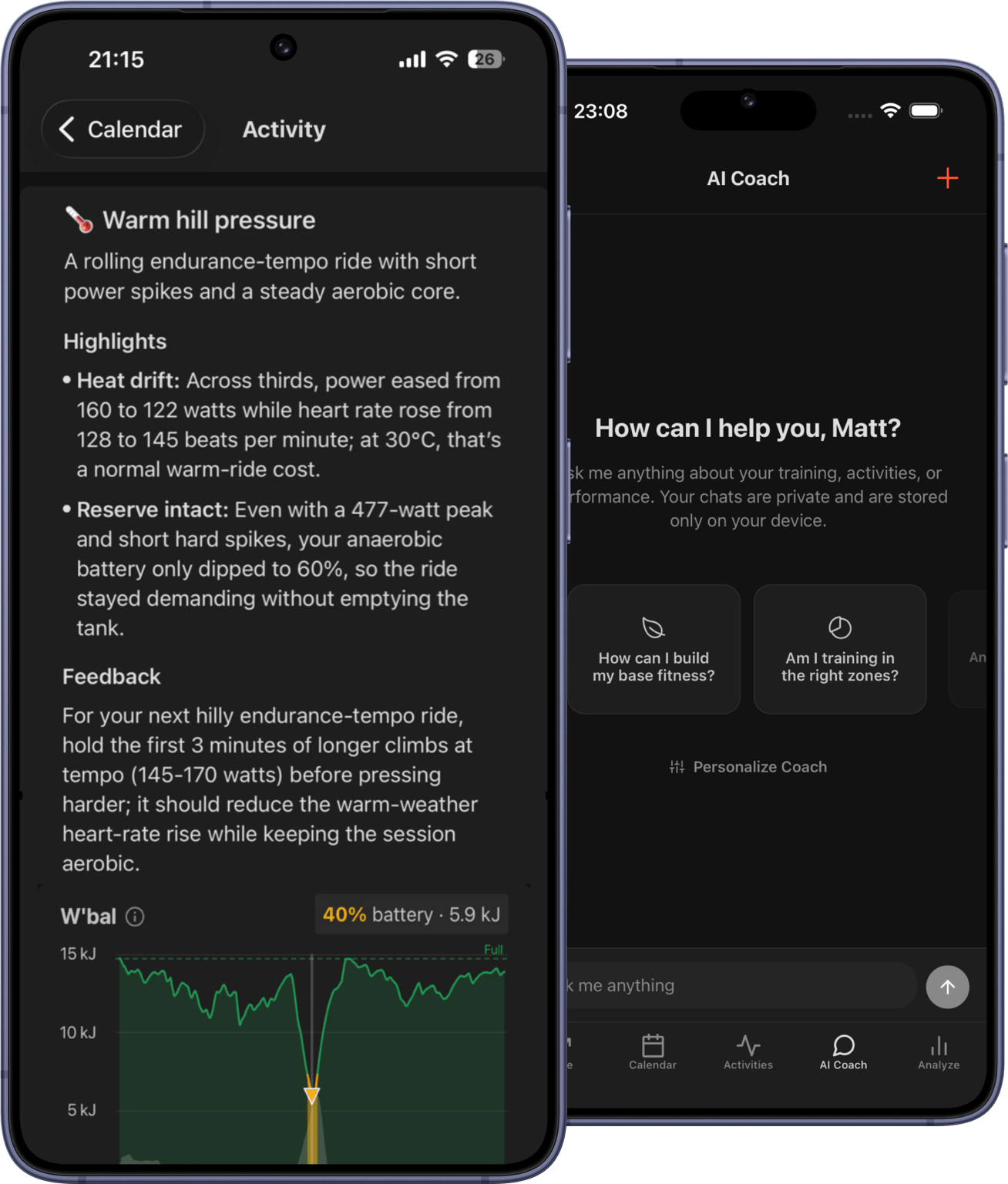
Ask FormBeat's AI Coach anything - what to ride today, why a session felt flat, how to pace your next race - and it answers from your real training: your power, your history, how you're recovering. Not generic tips, but a read of what each ride actually meant and what to do next.
The guidance you'd pay a coach for - for the price of an app.