Your Athlete Profile
Your power at different durations reveals your cycling DNA — whether you're built for sprints, climbs, time trials, or something in between.
Last updated: Jun 2026
Every cyclist has a unique power signature. Some can light it up for 10 seconds but fade on longer efforts. Others grind steadily for hours but can't match a pure sprinter's explosiveness. Most of us fall somewhere in between — with strengths we might not even realize we have.
Your Athlete Profile analyzes your ride data to reveal exactly where your strengths lie, and where there's room to grow.
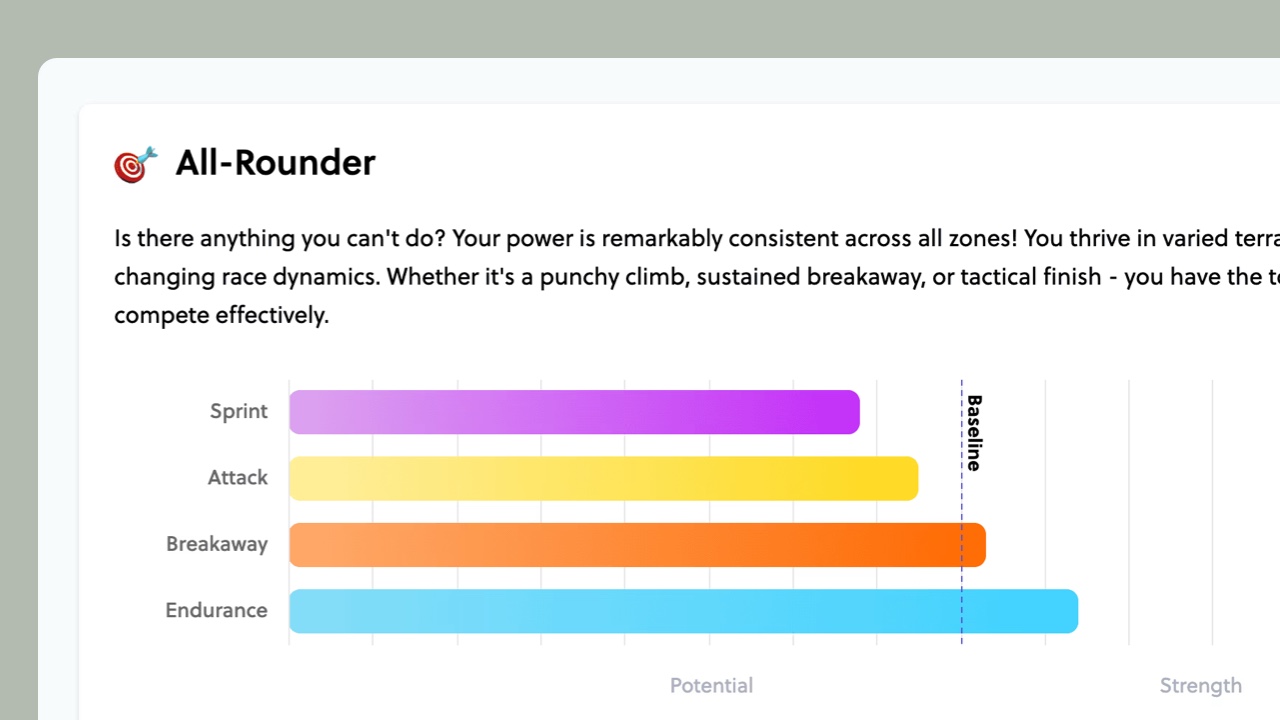
The four power durations that define you
Massive force for very short bursts. Wins town sign sprints. Influenced by genetics, but also by strength, technique, and neuromuscular training.
Work above threshold. Powers attacks and short climbs. Highly trainable with the right intervals.
Your aerobic ceiling. Determines sustained climb and breakaway performance. Responds to high-intensity work. Estimate yours.
Sustainable power for time trials and long climbs. Responds well to consistent training across a wide range of methods.
Efficiency — using what you have
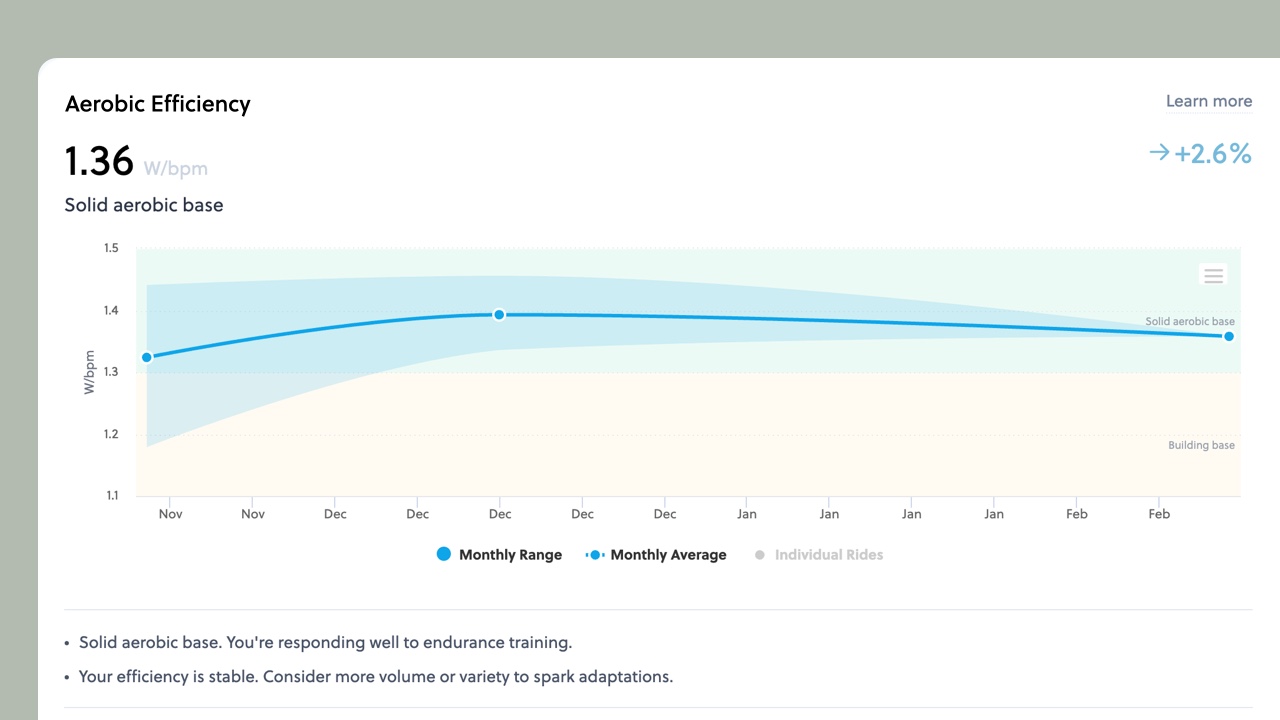
Raw power numbers only tell part of the story. Fractional Utilization shows how much of your VO2max you can actually sustain at threshold. Think of VO2max as your engine size and FTP as how much of that engine you can use for long efforts.
A high Fractional Utilization (say, 85%+) means you're getting excellent mileage out of your aerobic system — your lactate threshold sits close to your ceiling. That's typical of well-trained endurance riders. If yours is lower, it means there's room to raise your FTP without needing a bigger engine — tempo and threshold work can close that gap.
The flip side: if your utilization is already very high, pushing FTP further means you'll need to raise your VO2max first. The ceiling has to go up before the floor can follow. This is where high-intensity intervals and VO2max-targeted work come in.
Your strengths and growth opportunities
FormBeat doesn't just show you numbers — it highlights where you're strongest and where you have the most room to grow. Based on how your power durations compare to each other, you'll see a personalized breakdown like:
The duration where you stand out relative to the rest of your profile. If threshold power is your thing, you're built for time trials and sustained efforts. If it's sprint power, you've got the punch for breakaways and finishes.
The area with the most potential for improvement. This isn't a weakness — it's where targeted training can make the biggest difference. A few weeks of focused intervals can shift this noticeably.
How we calculate your profile
We pull your peak power outputs across the four key durations from your last 90 days of riding. But instead of just ranking your raw watts, we compare your actual power at each duration against what's expected for a rider at your overall fitness level — using established power benchmarks from exercise science research.
This is what makes it useful. Two riders with the same FTP can have completely different profiles. One might produce exceptional 5-minute power relative to their fitness level but average sprint numbers. The other might be the opposite. By measuring each dimension against your own baseline, we reveal your shape as an athlete — not just your size.
We also apply a Critical Power model to your data. This mathematical relationship between power and duration helps us estimate your sustainable threshold and anaerobic work capacity from your everyday rides — no lab test needed.
The result is a profile that shows not just how strong you are, but what kind of rider you are — sprinter, climber, time trialist, or all-rounder.
What this means for your training
Your profile isn't destiny — it's a starting point. If you know you're weak at 1-minute efforts, you can target that with specific intervals. If your 5-minute power is your strength, you know what kind of events suit you best.
Over time, watch how your profile changes. Training shifts it. A winter of base work will grow your threshold slice. A block of VO2max intervals will expand your 5-minute power. The profile becomes a record of how you're developing as an athlete.
Most importantly: knowing your strengths helps you race smarter. Play to them when it matters.
Requirements
Your Athlete Profile requires a power meter. Without power data, there's nothing to build a profile from — heart rate alone doesn't give us the resolution needed to compare efforts across different durations. If you ride with a power meter, your profile builds automatically as you accumulate rides.