Training Load
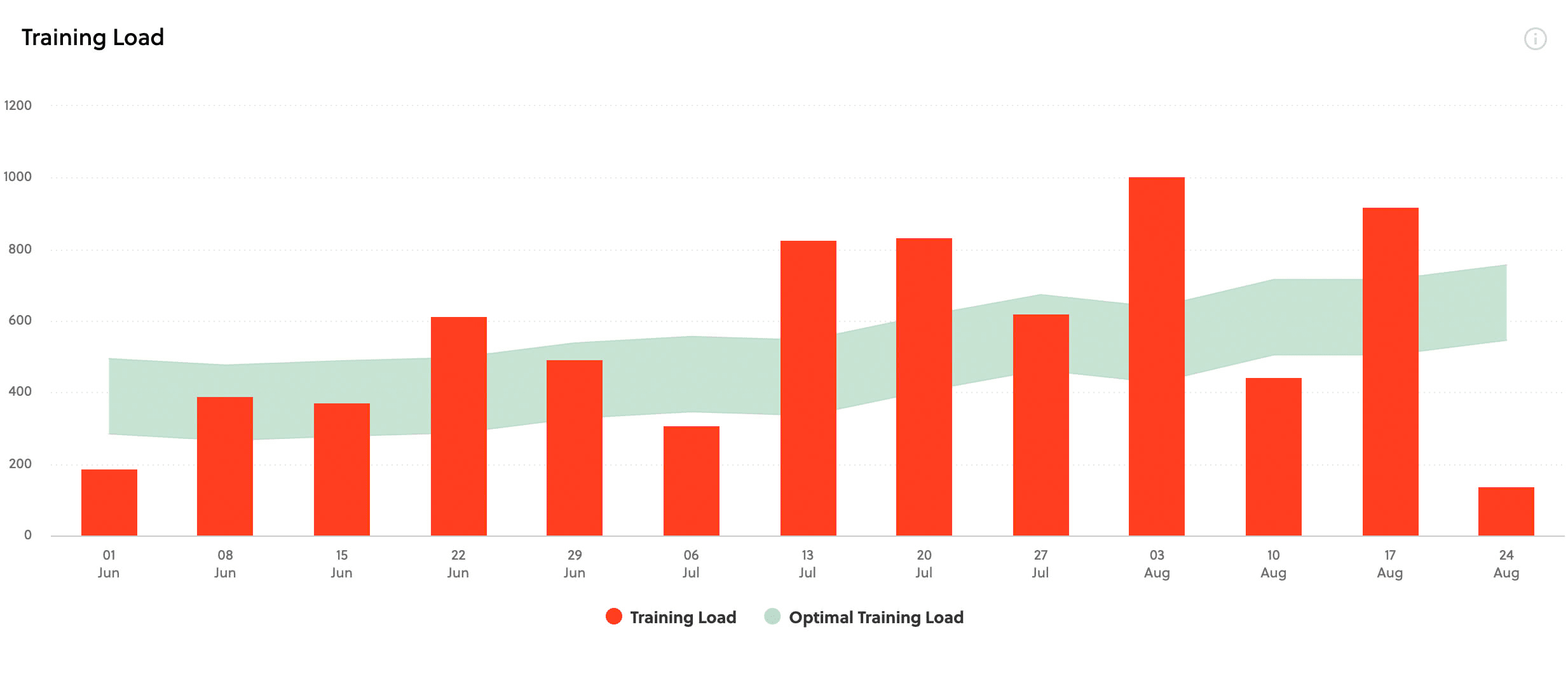
Training Load represents the accumulated Training Stress Score from activities in a given week. It is a great way to see how hard you have trained each week.
Besides your measured training load, FormBeat will calculate your optimal training load range for each week, which is based on your past training. Training in the optimal range will help you maintain and improve your overall fitness.
What's a good number? Aim to spend most weeks inside your optimal range — that's enough to build fitness without digging a hole. But the range isn't a permanent target: dropping below it on purpose during a recovery week or a taper is exactly right, and a flat training load while your FTP keeps rising still means you're getting stronger. Consistency over months matters more than hitting the band every single week.
Weekly Training Load Estimator
Enter your average weekly TSS from the last 4-6 weeks to get rule-of-thumb ranges for your next weeks.
Acute vs Chronic Load: CTL, ATL, and TSB
Weekly totals are the simple view. Underneath, training load is tracked as two rolling averages of your daily TSS that decay at different speeds:
- CTL (Chronic Training Load) - a ~42-day weighted average. This is your fitness : the work your body has absorbed and adapted to. It moves slowly, which is the point.
- ATL (Acute Training Load) - a ~7-day weighted average. This is your fatigue: it spikes after big days and fades within a week of easy riding.
- TSB (Training Stress Balance) - CTL minus ATL, your form. Negative TSB means you're carrying fatigue (normal in a build); positive TSB means you're fresh (what you want on race day).
The art of training is pushing ATL high enough, for long enough, to drag CTL upward - without letting the gap become so large that you break down instead of adapting.
How Fast Can You Ramp?
The most useful guardrail is the ramp rate: how many CTL points you add per week. Around 3-5 CTL per week is sustainable for most riders; 5-7 is aggressive and best kept short; beyond 8 the risk of illness, injury, and non-functional overreaching rises sharply. A related lens is the acute:chronic workload ratio (ACWR) - your last 7 days of load divided by the last 28. Keeping it between roughly 0.8 and 1.3 is the sweet spot; above 1.5 is the danger zone where injury risk climbs fastest.
Two quieter saboteurs are worth knowing. Monotony - doing nearly the same load every day - raises strain even at moderate volumes; hard days and genuinely easy days beat a grey middle. And chronically low load is a risk of its own: ramping into a big event from too small a base is how underprepared athletes get hurt.
Reading Your Training Load Week to Week
A practical weekly rhythm for self-coached riders:
- Build weeks (2-3 in a row) - weekly TSS slightly above your recent average, nudging CTL up a few points.
- Recovery week (every 3rd-4th) - cut volume to 50-60%. Fitness barely drops; fatigue clears; adaptation lands.
- Before key events - taper load so TSB climbs positive while CTL stays high: fit and fresh.
Warning signs that load has outrun recovery: declining power at the same effort, elevated morning heart rate, poor sleep, irritability, and dreading workouts you normally enjoy. Two or more of those for several days is your cue for an early recovery week - not a harder one.
Your Optimal Range, Computed for You
Generic rules of thumb only go so far - the right load depends on your history, your recovery, and how your fitness is trending. FormBeat draws your personal optimal training load band on the weekly chart (the image at the top of this page), recalculated every week from your actual riding. Stay in the band and fitness builds sustainably; the chart makes it obvious when a week ran too big or too small, and the training status reads the trend for you.
Know your optimal load every week
FormBeat computes your personal training load range from your real riding - then tells you each morning whether to push, hold, or recover.
30-day free trial · Cancel anytime


“If you find yourself wishing there was just one simple resource you could rely on to fully explain, examine and guide your training, FormBeat could be your answer.”
 Trusted by 20,000+ cyclists